Here’s a contents page of my posts .

Experience of Benefits, shared
The story-telling ape and how he spoils your choices.

“In last week’s email, we shared how different business owners were winning the selling game by telling great stories.”
A typical business development blog
Those of you who like their education with a bit of entertainment may well know the series of books on the Science of Discworld by Terry Pratchett, Ian Stewart and Jack Cohen. One of the minor items that falls out of their broad remit of the whole of science is Pan Narrans, the storytelling ape (The Science of Discworld II – The Globe). Very briefly, instead of being Homo Sapiens, mankind ought to be described as Pan Narrans as we’re not much above the chimpanzee, we simply tell stories more eloquently.
It’s this evolutionary development of storytelling and our dependence upon it that affects the way we act together and the choices that we make, not always in a good way.
“History is written by the winners. Though not greyhounds and racehorses.”
Alexei Sayle’s Imaginary Sandwich Bar – Britain’s place in the world, Radio 4, 09/11/17
What about the content of the story, the plot, the characters?
I once went to a business seminar, the sort where the panel of millionaires takes questions. Inevitably, the question arose, “As a truly successful businessman, what is your advice to an entrepreneur just starting out?”
Came the, also inevitable answer, “Don’t give up. Keep at it. Eventually, you’ll make a sale.”
Then the epiphany struck me. The answer boiled down to, “Keep pushing your stupid product until you find someone more stupid than you who will buy it.”
Stories have heroes who live to tell the tale, they have million to one chances, they have the rewards of perseverance. Reality has heroes who never come back, punters who bet all and lose, unrequited lovers who die old and lonely and unfulfilled. And it has many more of all three.
Two-thirds of companies fail within three years. Sixty per cent of projects fail. If we base too many of our choices on the stories we hear from the lucky few then we risk falling into the unlucky many.
That doesn’t mean we shouldn’t try, that we shouldn’t be inspired, that we shouldn’t hope. It means that we ought to consider the chances of success and the consequences for ourselves and those close to us. Re-possessed houses rarely have only one occupant. Bankrupt firms have workforces.
It means putting in the effort up-front to make the best choices in the first place. Von Clausewitz talks about the selection and maintenance of the aim. Maintenance is great if you selected the right thing in the first place. It has its downside when you picked the wrong one.
I know that stories appeal to our emotion, not our rationality. I’m just asking that we take a pause and put a little rationality into the mix before taking that leap of faith.
We’ll always need stories. We are Pan Narrans after all. What we need is the right sort of stories. “Once upon a time, a group got together and worked on a problem until they came up with a sensible solution…”
A bit more than a Benefits Map
Start with the end in mind.
I’ve never been totally happy with the focus on benefits over objectives. It’s always felt incomplete. Benefits Realisation / Benefits Management doesn’t provide sufficient emphasis on purpose or strategy. Too often, benefits are rewards promised so people will permit, enable or justify decisions that have already been made.
The Benefits Map or Benefits Dependency Network ought to be a serious tool for selecting and delivering value from change. In many cases, it isn’t used at all. In others, it doesn’t produce the quality results that it could because people drift to the small tactical benefits (rewards to keep the users happy) instead of big strategic objectives.
The Goal Model is a type of Benefits Map. However, its scope is broader than benefits and it applies to more than projects, so I took ‘Benefits’ out of the name. By modelling Goals instead of mapping Benefits, I hope to keep the emphasis on purpose and strategy.
The Goal Model is a picture that shows the net of resources and their cause-effect applications between an initiative (process, project, programme, portfolio) and the strategic objective(s) to which it contributes.
Building the Goal Model
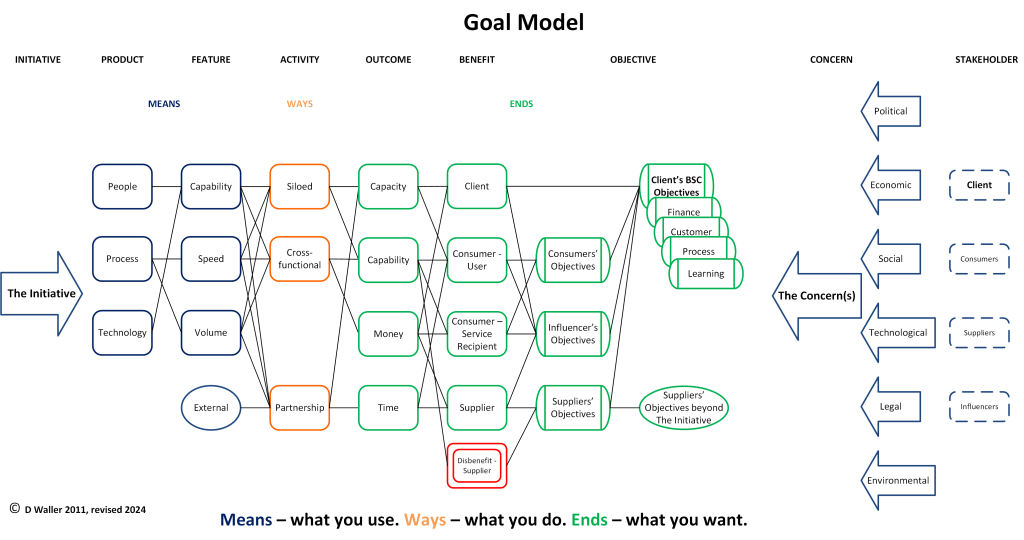
This is a general summary of what the completed Goal Model will contain. It’s a map of the cause-effect nets between the Concern(s) to be addressed and the Initiative that addresses it. It’s a picture of the ‘to be’ end-state. It doesn’t include any project or business change activity that gets you to this end-state. Between the Initiative and Concern are the Means, Ways and Ends that connect them. These are split into items such as Product, Activity, etc. with some example ways to categorise the items, e.g. people, process, technology Products or Balanced Scorecard Objectives.
Concern
The Concerns summarise the business environment, the context in which you operate, often described as the Problem Statement that triggers a change. They may be straightforward, such as a direct order from above, or more subtle like personal beliefs and mores. PESTLE is one method of categorising Concerns.
For the simplest change there may be only one Concern: “Our client demands that we do X”. You may face many Concerns. They will have to be sifted and prioritised if you are to manage them. Plotting them on the model is a strong visual way of appreciating what’s rational and feasible. The key Concern(s) sits closest to the Objective. The others sit further out, in decreasing importance.
Stakeholder
Stakeholders are the relevant actors, impacting and / or impacted by the Initiative. They may be individual people, groups or entire populations. The same stakeholder can play more than one role.
There is only one Client. The Client is the stakeholder who wants the initiative and pays for it. Sponsor or SRO are types of Client. They act for themselves, the consumers and influencers.
Consumers are the ones using the new initiative and / or receiving its effects, e.g. staff and their customers. They live with the results, but they may not have much direct control over it.
Suppliers give the Client what they want. Consumers acting in the design and implementation of the Initiative are temporary Suppliers.
Influencers is a much broader group of stakeholders, allies, adversaries and indifferents, some of whom play no practical role in the Initiative but who affect the client’s decisions. Consumers and Suppliers are groups of Influencers in that they can directly affect the Initiative. Your competitors are major Influencers.
Initiative
The Initiative is a bounded solution, the overall business change to be made, the programme or project. Naming it helps to set the scope and the boundaries. Its description must be concise and meaningful so people can understand what you’re making. The Client, as the ultimate stakeholder wants the Initiative for their own Objectives and Benefits. They permit the Objectives and Benefits of the Consumers, Influencers and Suppliers.
Ends are what you want to achieve. They are Outcomes that lead to Benefits that in turn lead to Objectives.
Objective
Balanced Scorecard is one way of categorising Objectives. Alternatively, you may have specific local categories, e.g. the organisation’s Five Year Plan. There may be separate sets of Objectives for each stakeholder group but the Client’s take precedence. These may all be shown in the single model or acknowledged and referred out to, e.g. Supplier’s profit is their worry and external to the Client’s Initiative.
Objectives should be SMART. Concerns might be nebulous, e.g. mission and vision statements, customer wants, etc. but Objectives must be pretty firm. If you are going to be judged on how well you achieved your Objectives, then you need an agreed way to measure them.
Benefit
Benefits can be split by the stakeholder group that receives them, and also by type (cash, non-cash, etc.) to inform the business case. A Benefit contributes to an Objective and comes from the Outcomes.
Disbenefits are the negative result or detriment to a stakeholder. Categorise them the same way as Benefits.
Outcome
Measurable outcomes are produced by the Ways. Outcomes may be resources created / released.
Activity
Ways are the Activities that consumers do and how they do them. They are business processes or personal actions that use the Means and produce the Outcomes. Note that they are not business changes. They are business activities in the new ‘to be’ state, after the change has been made.
Product
Means are the resources that consumers use. They are new or changed assets that enable the Ways. Means begin with the Product, something provided by the Initiative that is tangible like a machine or intangible like a service.
Feature
Each Product has Features. These are the specific things that make the Product relevant and useful in context. Typically, they may be speed, volume or relevant capability.
External
Some items may be marked as ‘External’, e.g. dependencies, Means and Ways that are outside the project’s control, or the Suppliers’ Objectives beyond the Initiative. They are shown in the model in an ellipse, so they stand out from the internal stuff.
Unlike some Benefits Maps, project work and business change don’t belong in the Goal Model. The Model is all about the ‘to be’ state and not the action that has to happen in order to get there.
Each Product in the Means will have Product and Work Breakdowns (or Agile equivalents) from the project that created it. It’s also likely that Activities in the Ways section will also have similar breakdowns for the business changes and assumptions around them. Behind each item and connection is a set of assumptions and risks. They can’t all fit in the model, but they are important things to consider and must be recorded somewhere. Putting them all in the Model will make it unusable. However, if you have one or two critical items that you can’t afford to ignore, then annotate your Model with some brief comments.
The Goal Model summarised
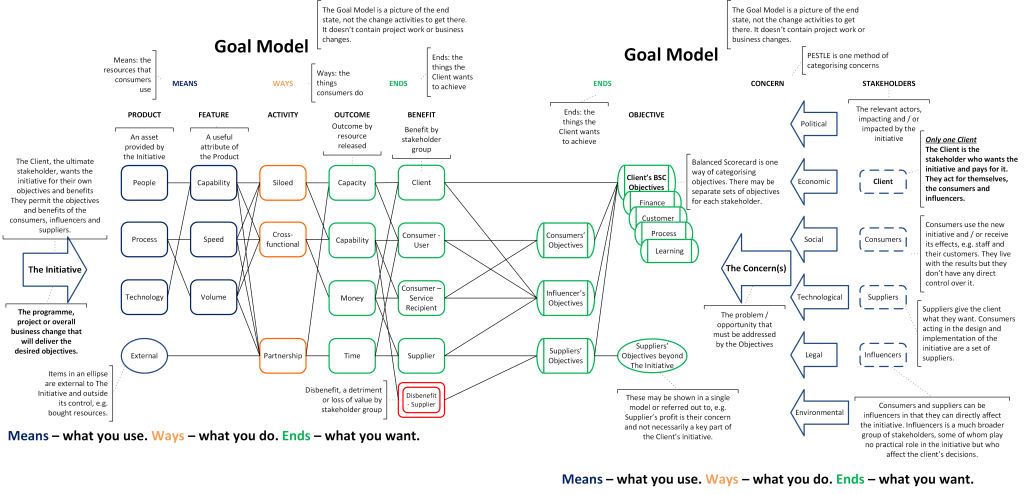
A picture paints a thousand words (more like 1500 in this case…) This is the Goal Model with explanatory notes. It’s worth study and it’s worth practice. Used well, it’s a terrific tool for making strategic choices and getting the value from your change.
For a deeper explanation of the Goal Model and how to build one, see: https://www.benefitofexperience.com/images/library/The_Goal_Model.pptx
The complete story is in my book The Goal Model: Designing Business Decisions available from Amazon The Goal Model: Designing Business Decisions eBook : Waller, David: Amazon.co.uk: Kindle Store
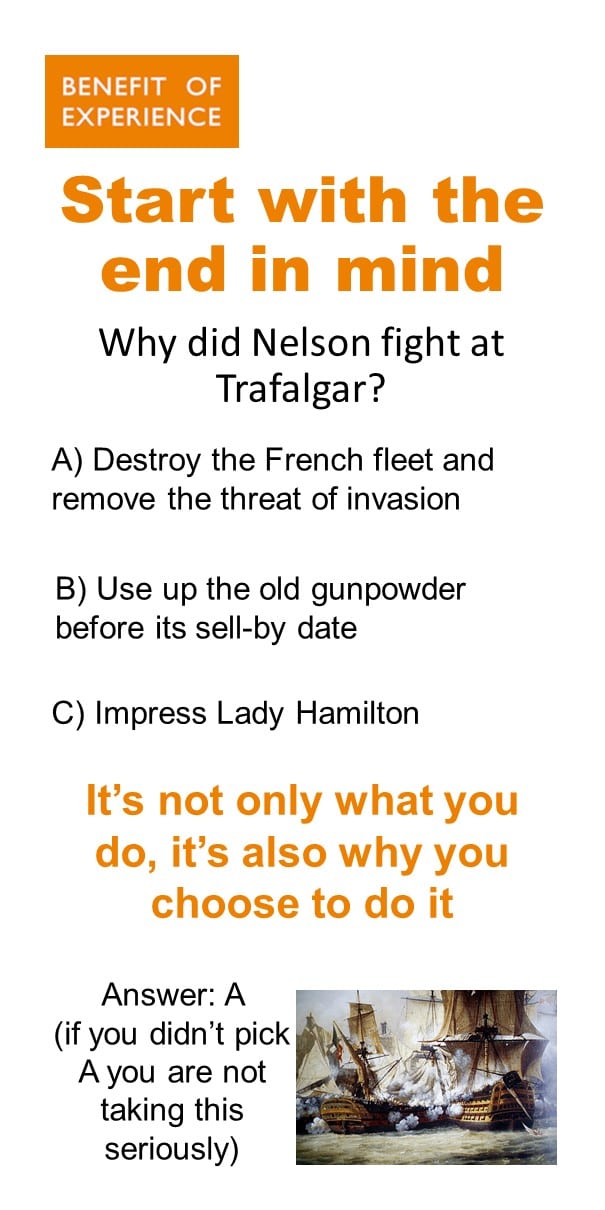
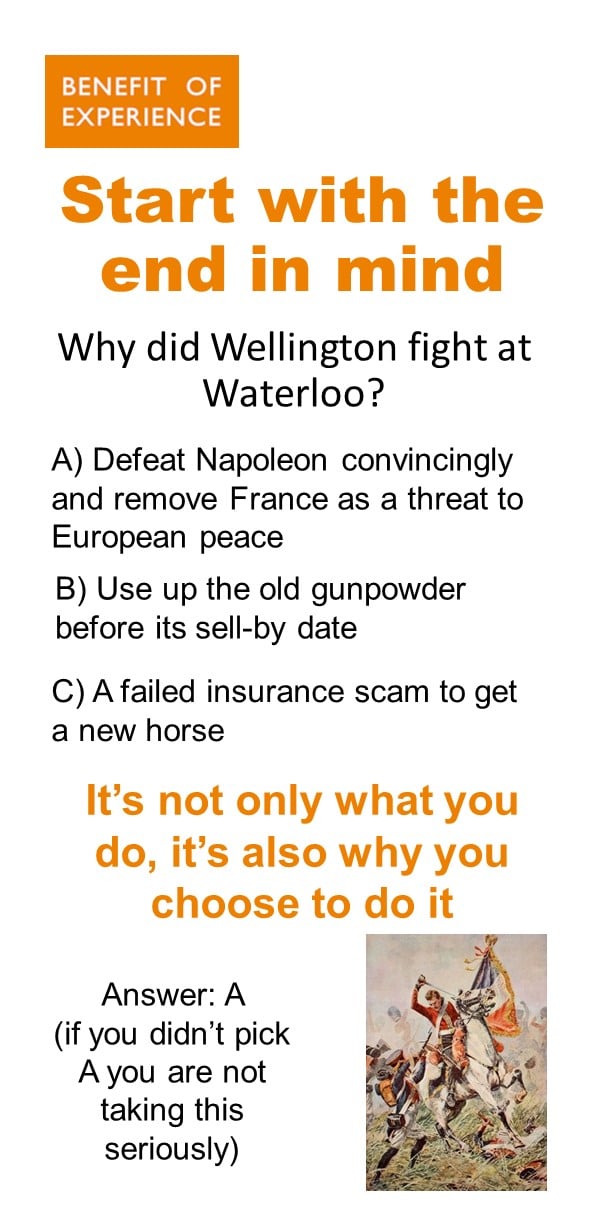
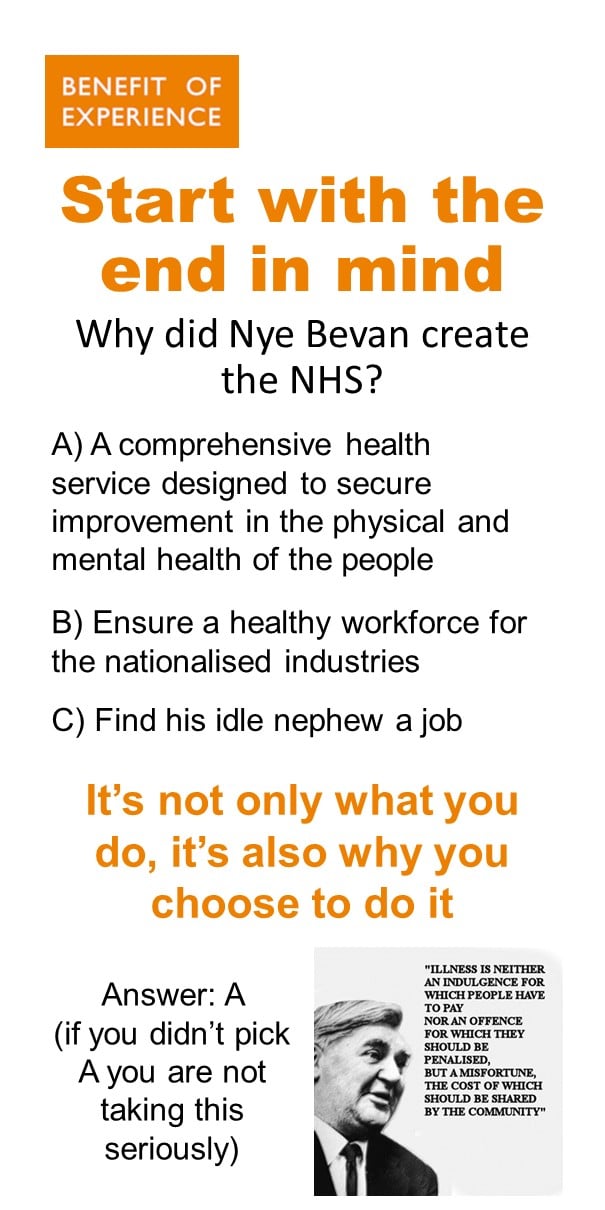
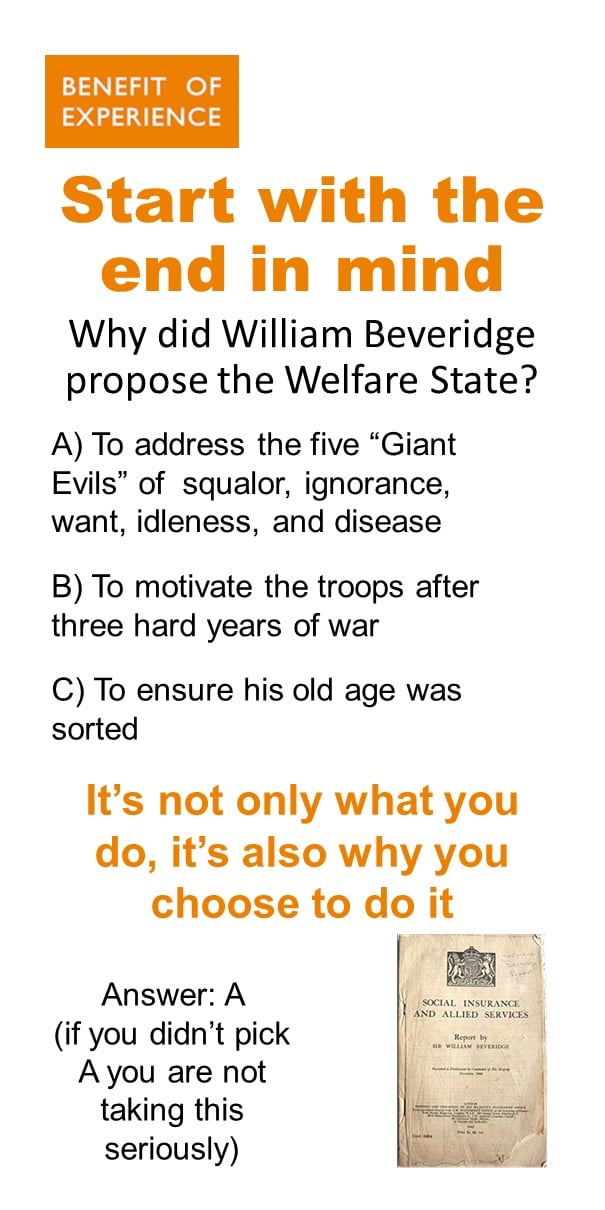
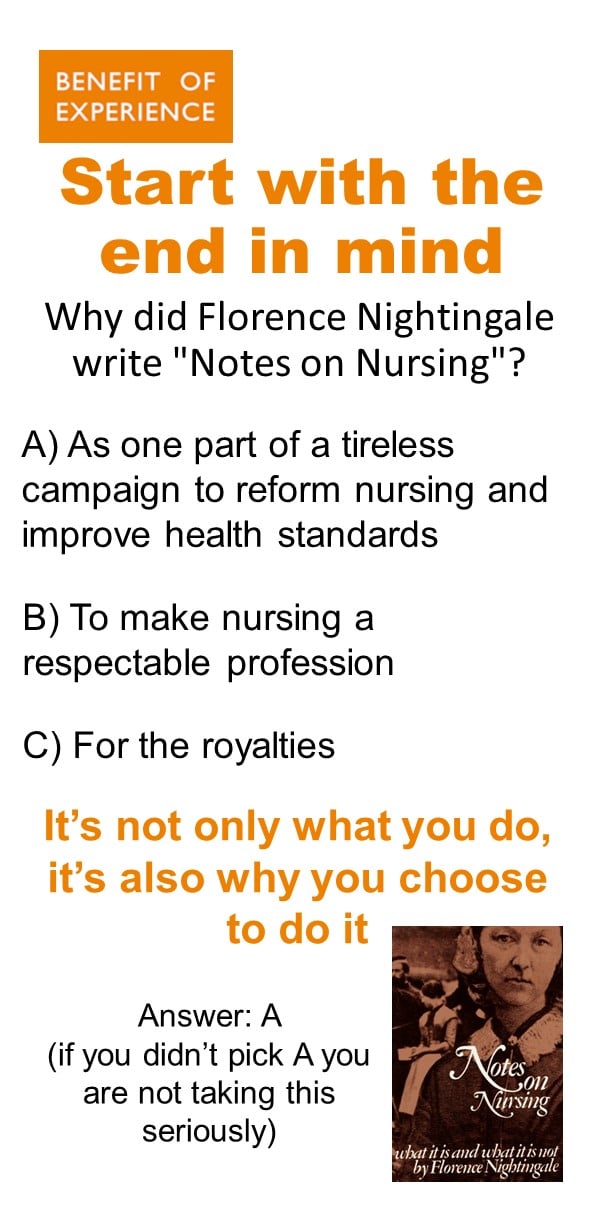
Start with the end in mind – a good motto for life as well as work. It’s blatantly obvious but rarely done properly. The purpose behind any course of action has a direct and significant effect on the way it is undertaken. The reasons why affect the ways we go about things.
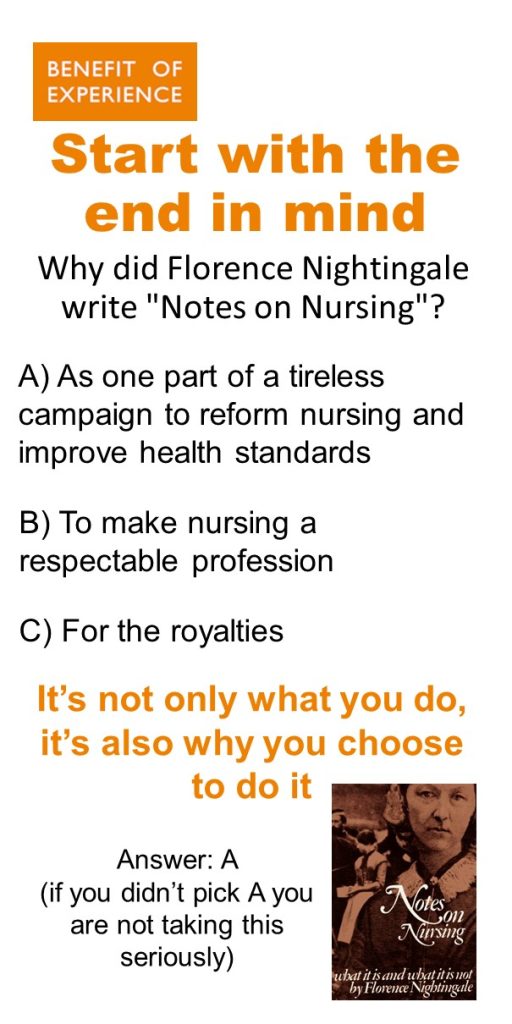
If Florence Nightingale had set out just to make nursing a respectable job for the daughters of the lower-middle class then her achievements for patients would have been very different.
Here’s a sports analogy, a football manager’s side and tactics will adapt to the objective:
The same applies for any project, the ends affect the means and ways. Projects talk of acceptance criteria, the things that decide when the project has ended successfully, a sort of, “No-one goes home until…”
Define your acceptance criteria in terms of objectives and benefits before you start. Don’t install the kit and then wonder what to do with it. Too often, projects leave benefits realisation until it’s too late, i.e. at the end of the project. That’s why benefits should be managed from the start.
Some organisations demand a hard financial return.
Some want intangible improvements like satisfaction and image.
Usually, they want both. That’s when conflicting objectives throw a spanner in the works. That’s why clear objectives are crucial.
Florence Nightingale and other examples are available as phone lock-screen pics:
The Idea Test
Hypothesis testing is a way of testing new ideas against your strategy, objectives and context. Before running away with a brilliant new idea, it needs to be checked to see how good it really is and how well it fits with who you are and what you do.
No-one enjoys getting their homework marked, and the same applies with any business assurance process. By the time you hand over your business case to be sense-checked by colleagues, you will already have invested a lot personally, as well as financially. If it’s going through a formal approval process, you really don’t want to be rejected. If it’s the subject of an audit, then it’s probably too late to correct anything and your reputation will be defined by their findings.
Even when all goes well and assurance re-assures you that you’re doing things right, there’s always that period of doubt and anxiety until you get the OK.
If re-assurance is someone taking away your worry after the event, then ‘pre-assurance’ is what you do to take away the cause for worry in the first place. Pre-assurance is all about testing your decision before you pass it over to someone else for comment.
The Idea Test is one way to pre-assure your initiative. It’s a way of testing new ideas against your strategy, objectives and context. Before running away with a brilliant new idea, it needs to be checked to see how good it really is and how well it fits with who you are and what you do.
The Idea Test contains checks to take you from hypotheticals to practicality. There are four filters for your investment decision to pass through or fail:
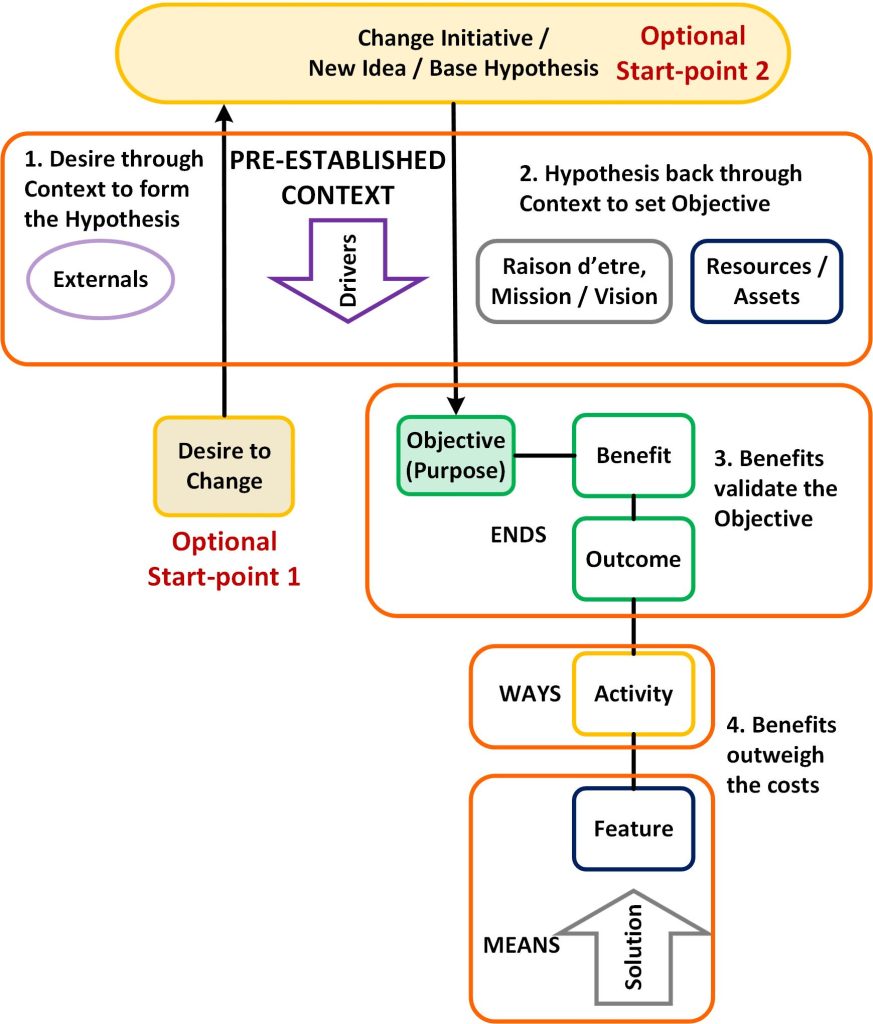
The Idea Test
Pre-established Context
To begin with, you have to set the scene, to understand the context in which you operate. If you don’t know where you are, you can’t be sure where your change will take you.
Who are you, what do you do, what do you think? Understand the purpose and culture of the organisation. What’s your Vision and Mission, your raison d’être? What drives you from outside? Know the externals you work with (competitors, customers, suppliers, partners, society). What resources do you have, physical and intangible, kit and people?
Optional Start-point 1, Desire to Change
Then you can choose to change. At this point, you may not have a particular change in mind. You just know that you can’t stand still, something must be done. Start here if you’re looking for inspiration.
First filter – pass your desire to change through the context to see where the opportunities or gaps lie. Use the Context for some horizon scanning. “What’s happening out there?” “What could be better…?” “What should we fix…?” Try some SWOT analysis. If you don’t already have a Problem Statement, this is where you can create one.
Optional Start-point 2, the Base Hypothesis
The first filter takes your vague desire to change and turns it into a Base Hypothesis, “Why don’t we…?” “Wouldn’t it be good if…?” Often though, someone’s already had the idea and you start here with the Base Hypothesis. If you’re lucky, it’s come from a workshop of rational experts. If not, it’s probably something your boss heard at the Golf Club. Either way, it needs to be checked.
Second filter – pass the Hypothesis through the context to see if it’s relevant, appropriate and feasible. Will your new idea be good for your business? Do you have the capacity and capability to do it?
Are you comfortable that it fits with the sort of people you are? A silly example – you’re the local Temperance Lodge and you need to raise funds. Someone suggests opening a members’ bar. It really doesn’t fit that well with your mission. A more sensible historic example – the supermarket Tesco was basically a giant grocer. Then someone suggested selling financial services. At first sight there’s no connection but thinking about it, Tesco has a huge customer base and knows a lot about their financial state. The company’s purpose is to make profit. The idea made commercial sense and Tesco Bank still exists.
Turn the Hypothesis into an Objective. Go from, “Why don’t we do X?” to, “We will do X because…” The ‘because’ is vital, even if it’s implicit. The purpose behind any course of action has a direct and significant effect on the way it is undertaken. The same applies for any project, the ends affect the means and ways. That’s why a few, clear, SMART objectives are crucial.
You have an objective, a result with a significant and agreed purpose. The next step is to establish the benefits. Most ‘Benefits’ you will see aren’t benefits at all. They’re system features or outcomes, it’s small, fast, painted in friendly colours… So, what is a benefit?
A benefit is a result that a stakeholder perceives to be of value
A benefit needs a stakeholder, someone has to see its merit. “What’s in it for me?” is a subjective judgement.
We use benefits as an aid to setting good objectives. It’s reasonable to expect that our objective will be something to do with bringing benefit to someone, even if it’s purely selfishly to ourselves. The moral and ethical issues can keep for another article. The key points here are a benefit needs a stakeholder, someone has to see its merit, and perception is crucial. “What’s in it for me?” is a subjective judgement. Like morality, issues of relative value, altruism and perverse choices can be left for another day.
However, the definition of benefit helps us define the things around it like outcome and objective. Get away from features and outcomes. It’s got to be perceived as being valuable, e.g. improving sales, reducing complaints, stopping costly processes, not improving network performance, reducing down-time and stopping legacy systems. Use a Benefits Map to plot the cause – effect links.

A Generic Benefits Map
Third filter – test the Objective against the optimised package of benefits and detriments to see if it is desirable. “If we do X, we will get Y, and we really want Y.” Is the Objective big enough to bother? Too often we do projects without a clear up-front understanding of what benefits they will deliver. ‘Build it and they will come’ is a gamble that maybe we ought not take.
Different stakeholders want different things. Work out who you are doing it for and what they perceive as being valuable. Who are the key ones who have a significant influence on the project? What business changes will they make for the project to be successful? “What’s in it for them?” How committed to success will they be and where do we want them to be? Are the benefits appropriate? “You’re doing this because it brings substantial benefit to the right people”.
Knowing if the benefit will be substantial means putting a price on it. Your benefit may not be cash in the bank, but you still need to know what it’s worth, what you’d be willing to pay if you had to. Later, you’ll have to show that the benefits will outweigh the costs.
Now you have a good feel for what you want, plan to realise the Ends (Objective, Benefits, Outcomes) through the best use of Ways and Means. This is where the Benefits Map comes in useful again. Mapping makes the links and dependencies clearer than tables in a business case. Your plan must include costs and risks so you will know the expense and the chance of success.
Fourth filter – Test the benefits against the costed plan. Is the cost (money, time, stress, lost opportunities) outweighed by the benefits? Will your Big Idea add value?
Test the benefits it delivers against the costs involved to prove it is a worthwhile use of resources. You know the chains of cause – effect from Means to Ends. The benefits you have selected are feasible and properly quantified. You’ve accounted for risk and dependency, so the chances of success are reasonable. All things considered; will you get a satisfactory return on your investment? If not, what can you change in the scope or funding to make it worthwhile?
When your idea has passed through the four filters you know that it is:
You’ve got the makings of a good idea and the start of a successful business case. Then all you have to do is plan, implement, manage, etc., the entertaining stuff…
The Idea Test was introduced to the NHS in England to support the NHS Change Day campaign of 2013. It was updated in 2024 to include the initial desire to change.
Willingness to pay
Dr Johnson said that patriotism was the last refuge of a scoundrel. In business, I think it’s Executives’ implicit willingness to pay.
Willingness to Pay is often cited as a method to set a monetary value on an intangible result like satisfaction. You get the relevant people together and ask, “How much would you pay for X?” Ok, it’s open to anchoring, group-think and a host of other errors and abuses but it’s not alone in this. Asking people what score (of whatever measure) they would give X has all the same caveats. And it’s definitely better to ask than to assume.
Unfortunately, projects don’t make much formal use of Willingness to Pay. It’s considered too subjective and tenuous a way to quantify the value they add. They don’t like asking, “What would you pay for this new capability?”, and they avoid financial measures for intangible results. Yet perhaps the ultimate ‘Willingness to Pay’ is the project sponsor who says, “I’ll buy the story I’ve been given.”
The shoddy project starts when a sponsor is given a sales pitch or a business case and says, “I’m willing to pay £X for the comfort / satisfaction / personal gain I will get from the story I’ve just been sold.” Then it’s disguised in a raft of ‘benefits’ to justify this decision. All the output measures and PR stories that the project will generate as it proceeds won’t hide the sad fact that it all hangs on a single decision based on an unconscious willingness to pay. A bit of sensible, honest analysis at the start can prevent this.
I work from the basis that a benefit is a result that a stakeholder perceives to be of value. Where I think we often go wrong is that we don’t identify (or admit to) the genuine stakeholders or understand their perception of value. Even the most shoddy and disastrous project will deliver some benefits. Unfortunately they will be the wrong benefits for the wrong people.
Typically, we believe our programme is so wide ranging, so culture-changing and so flexible that we couldn’t possibly put a price on the benefits. That’s when we should look at the stakeholders and make an honest admission of just who benefits from all the work. That’s when we might discover that the stakeholders who gain financially are the people being paid to do the programme. The people who gain satisfaction are the ones who sponsor the programme. As for the people being done to, the end users and customers, they’re not getting much out of it at all.
Let’s look at value. I believe that any benefit can be expressed in financial terms. It’s simply (simply!) a matter of currency conversion. That said, the accuracy and consistency of that financial value will vary widely over time and between situations and subjective opinion. Our personal willingness to pay varies with our knowledge of the market, our mood and the cash in our pocket. Multiply that by all the people involved in a business programme and financial value will always be a moving target.
This is why some people argue against hard cash statements. Within programmes and projects it’s possible to compare benefits by means of local weighted scoring systems. In the end though, these turn out to be a local currency. Be they Brownie Points, Beer Tokens or Corporate Achievement Indices, they are still a currency and as such, can be converted by market forces into other currencies just like £ to $.
Market forces set the value of products and services. The numbers drop out of the system. At least they do where the market is established. In creative and innovative projects the firm numbers just won’t exist so we have to stretch the error bars and invest a bit more to mitigate the extra risk.
The Public Sector has its own, unique problems here. Putting a value on human health, wellbeing and happiness in a political context is never going to be straightforward. However, there are ways and means. It is a matter of coming to an agreement on some common standards. Given the size of populations involved, even rough statistical estimates will do. After all, the accountants have been apportioning costs this way for years. Unfortunately, rational argument alone will not suffice here. Politics, pressure groups and personal agendas all get in the way of a common agreement.
If we accept that any common standards are going to be loosely defined to begin with then we can do something here. NICE know about the cost effectiveness of medicines, HSE can tell you how much to spend on avoiding death and injury. Ask DfE what illiteracy will cost someone over their lifetime.
A catalogue of reference benefits would be really useful. It will need both credibility and content though. I suspect the content exists in penny packets. Apart from the Civil Service examples there must be plenty of big firms’ economists and little firms’ Benefits Managers who’ve got their own ready-reckoners. I know I’ve got mine. That’s where the credibility falls down at the start because no-one knows what’s already out there.
So, if this article strikes a chord get in touch. Let’s see what we can create to make our Willingness to Pay explicit and give our programmes and projects a more rational value.
Meanwhile, as Dr Johnson didn’t say, “Implicit willingness to pay is the last refuge of a scoundrel”.