
A bit more than a Benefits Map
Start with the end in mind.
I’ve never been totally happy with the focus on benefits over objectives. It’s always felt incomplete. Benefits Realisation / Benefits Management doesn’t provide sufficient emphasis on purpose or strategy. Too often, benefits are rewards promised so people will permit, enable or justify decisions that have already been made.
The Benefits Map or Benefits Dependency Network ought to be a serious tool for selecting and delivering value from change. In many cases, it isn’t used at all. In others, it doesn’t produce the quality results that it could because people drift to the small tactical benefits (rewards to keep the users happy) instead of big strategic objectives.
The Goal Model is a type of Benefits Map. However, its scope is broader than benefits and it applies to more than projects, so I took ‘Benefits’ out of the name. By modelling Goals instead of mapping Benefits, I hope to keep the emphasis on purpose and strategy.
The Goal Model is a picture that shows the net of resources and their cause-effect applications between an initiative (process, project, programme, portfolio) and the strategic objective(s) to which it contributes.
Building the Goal Model
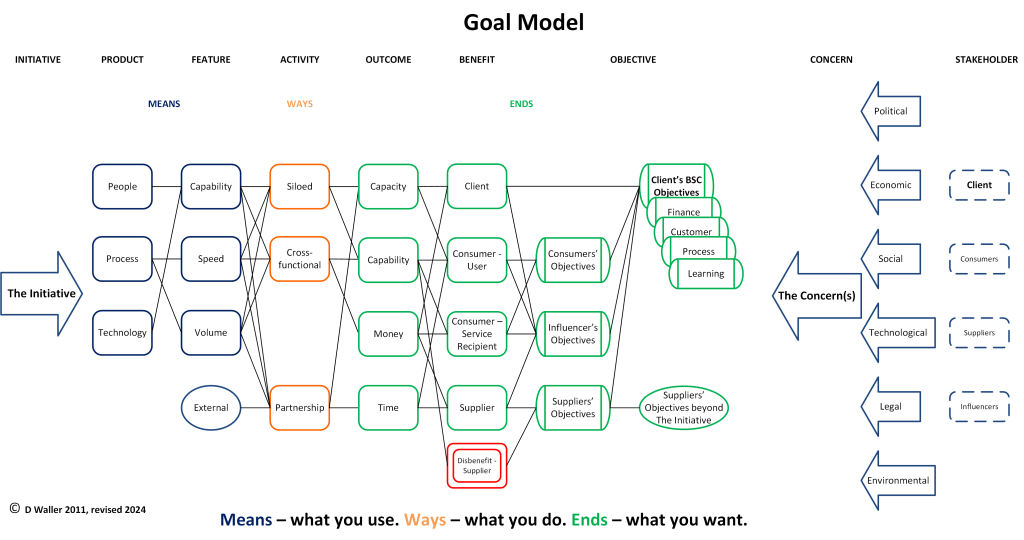
This is a general summary of what the completed Goal Model will contain. It’s a map of the cause-effect nets between the Concern(s) to be addressed and the Initiative that addresses it. It’s a picture of the ‘to be’ end-state. It doesn’t include any project or business change activity that gets you to this end-state. Between the Initiative and Concern are the Means, Ways and Ends that connect them. These are split into items such as Product, Activity, etc. with some example ways to categorise the items, e.g. people, process, technology Products or Balanced Scorecard Objectives.
Concern
The Concerns summarise the business environment, the context in which you operate, often described as the Problem Statement that triggers a change. They may be straightforward, such as a direct order from above, or more subtle like personal beliefs and mores. PESTLE is one method of categorising Concerns.
For the simplest change there may be only one Concern: “Our client demands that we do X”. You may face many Concerns. They will have to be sifted and prioritised if you are to manage them. Plotting them on the model is a strong visual way of appreciating what’s rational and feasible. The key Concern(s) sits closest to the Objective. The others sit further out, in decreasing importance.
Stakeholder
Stakeholders are the relevant actors, impacting and / or impacted by the Initiative. They may be individual people, groups or entire populations. The same stakeholder can play more than one role.
There is only one Client. The Client is the stakeholder who wants the initiative and pays for it. Sponsor or SRO are types of Client. They act for themselves, the consumers and influencers.
Consumers are the ones using the new initiative and / or receiving its effects, e.g. staff and their customers. They live with the results, but they may not have much direct control over it.
Suppliers give the Client what they want. Consumers acting in the design and implementation of the Initiative are temporary Suppliers.
Influencers is a much broader group of stakeholders, allies, adversaries and indifferents, some of whom play no practical role in the Initiative but who affect the client’s decisions. Consumers and Suppliers are groups of Influencers in that they can directly affect the Initiative. Your competitors are major Influencers.
Initiative
The Initiative is a bounded solution, the overall business change to be made, the programme or project. Naming it helps to set the scope and the boundaries. Its description must be concise and meaningful so people can understand what you’re making. The Client, as the ultimate stakeholder wants the Initiative for their own Objectives and Benefits. They permit the Objectives and Benefits of the Consumers, Influencers and Suppliers.
Ends are what you want to achieve. They are Outcomes that lead to Benefits that in turn lead to Objectives.
Objective
Balanced Scorecard is one way of categorising Objectives. Alternatively, you may have specific local categories, e.g. the organisation’s Five Year Plan. There may be separate sets of Objectives for each stakeholder group but the Client’s take precedence. These may all be shown in the single model or acknowledged and referred out to, e.g. Supplier’s profit is their worry and external to the Client’s Initiative.
Objectives should be SMART. Concerns might be nebulous, e.g. mission and vision statements, customer wants, etc. but Objectives must be pretty firm. If you are going to be judged on how well you achieved your Objectives, then you need an agreed way to measure them.
Benefit
Benefits can be split by the stakeholder group that receives them, and also by type (cash, non-cash, etc.) to inform the business case. A Benefit contributes to an Objective and comes from the Outcomes.
Disbenefits are the negative result or detriment to a stakeholder. Categorise them the same way as Benefits.
Outcome
Measurable outcomes are produced by the Ways. Outcomes may be resources created / released.
Activity
Ways are the Activities that consumers do and how they do them. They are business processes or personal actions that use the Means and produce the Outcomes. Note that they are not business changes. They are business activities in the new ‘to be’ state, after the change has been made.
Product
Means are the resources that consumers use. They are new or changed assets that enable the Ways. Means begin with the Product, something provided by the Initiative that is tangible like a machine or intangible like a service.
Feature
Each Product has Features. These are the specific things that make the Product relevant and useful in context. Typically, they may be speed, volume or relevant capability.
External
Some items may be marked as ‘External’, e.g. dependencies, Means and Ways that are outside the project’s control, or the Suppliers’ Objectives beyond the Initiative. They are shown in the model in an ellipse, so they stand out from the internal stuff.
Unlike some Benefits Maps, project work and business change don’t belong in the Goal Model. The Model is all about the ‘to be’ state and not the action that has to happen in order to get there.
Each Product in the Means will have Product and Work Breakdowns (or Agile equivalents) from the project that created it. It’s also likely that Activities in the Ways section will also have similar breakdowns for the business changes and assumptions around them. Behind each item and connection is a set of assumptions and risks. They can’t all fit in the model, but they are important things to consider and must be recorded somewhere. Putting them all in the Model will make it unusable. However, if you have one or two critical items that you can’t afford to ignore, then annotate your Model with some brief comments.
The Goal Model summarised
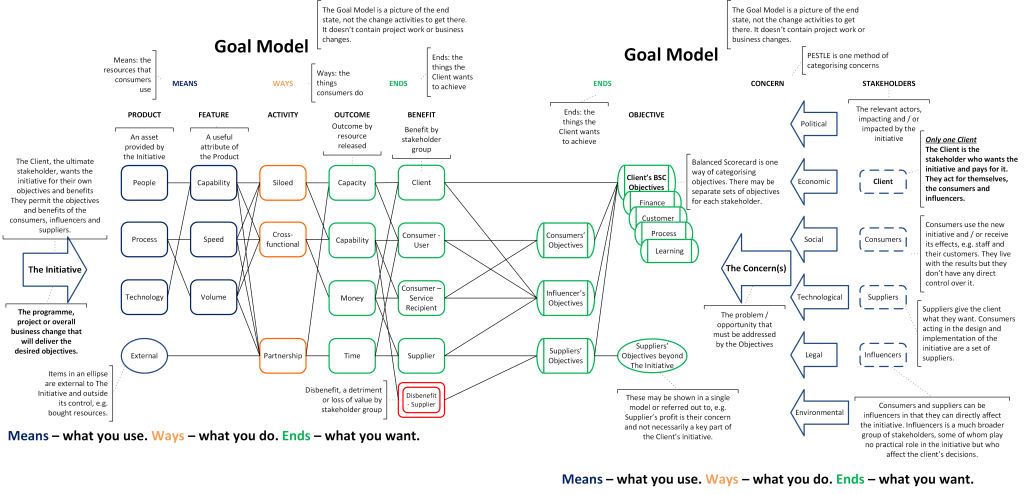
A picture paints a thousand words (more like 1500 in this case…) This is the Goal Model with explanatory notes. It’s worth study and it’s worth practice. Used well, it’s a terrific tool for making strategic choices and getting the value from your change.
For a deeper explanation of the Goal Model and how to build one, see The Goal Model in the Library.
The complete story is in my book The Goal Model: Designing Business Decisions available from Amazon The Goal Model: Designing Business Decisions eBook : Waller, David: Amazon.co.uk: Kindle Store