Author: benefitadmin

  • Agile BM

    Benefits in bite-sized bits…

    Agile delivers time-bound pieces of functionality. It has the flexibility to adapt to circumstances and lessons learned from previous time boxes.
    Benefits Management can work well in an Agile setting but it may have to run to keep up

    Flexible targets

    Traditionally, programme management sets more flexible targets than individual projects do. The scope and timescale of programmes are such that it’s clearly recognised that the world is moving on as they happen. Programme objectives can still be SMART, they are just a bit more fluid than project ones.
    The use of iteration, feedback and performance management (‘so far, so good’ benefits tracking) in programme benefits management helps keep the programme on track to deliver value, even when that value is emergent and unforeseen.
    The same approach can be scaled down for an Agile project. We can start with a SMART objective that’s defined by its boundaries, e.g. benefits of no less than X, delivered by time Y in location Z. The Benefits Realisation Plan will be coordinated with the Agile timetable and benefits will be staged with the project deliverables.
    Where Benefits Management starts running to keep up is in the need for constant review that fits with the Agile timetable. The developers meet regularly to assess what they achieved last period and how it will affect the plan for the next. This has to be controlled by the business’s assessment of the relevant benefits realisation. Every change to the plan must be weighed against the question, “Will it maintain or enhance the objective?” The business will consider:
    • Will the change realise our desired benefits?
    • Will it take us off-track?
    • Will it offer new opportunities that we must take?

    A developer’s flash of inspiration takes seconds, “I can tweak the code and give you X”. The appraisal of X is a significant exercise in quality control. The business skill will be in allocating the appropriate time and effort that trades off the new value you may get from changing the project specification against the cost and delay of assessing that value and making the change.
    It won’t be an easy task and it will require some mental stamina to keep up. However, it’s a task that has to be planned to ensure that your project delivers benefits and not just capabilities.

  • Benefits-led Agile

    A strategic wrap around tactical Sprints

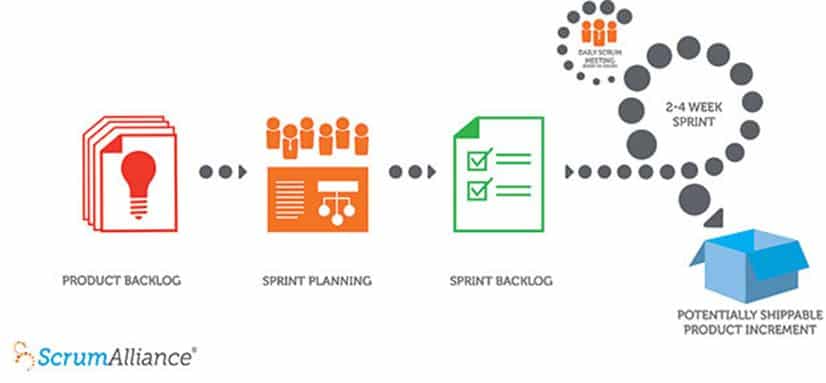
    Sprints begin with Product Owners describing their requirements and prioritising what gets done next. MoSCoW (must, should, could, won’t do) selection of what they want and the order they want it in sets the Product Backlog for the developers to concentrate on in the next round of work.


    It’s about delivering product increments, which suggests that you’ve a fair idea of what the end product should do, you’ve got a partially working model and the developers are adding that quality polish. It all seems a little tactical.
    Where’s the assurance that the optimum choices are being made in the first place? Where’s the strategy? Benefits-led Agile development puts a strategic wrap around tactical Sprints.

    Every change to the plan must be weighed against the question, “Will it maintain or enhance the objective?” The business will consider:
    • Will the change realise our desired benefits?
    • Will it take us off-track?
    • Will it offer new opportunities that we must take?

    A developer’s flash of inspiration takes seconds, “I can tweak the code and give you X”. The appraisal of X is a significant exercise in change control. The business skill will be in allocating the appropriate time and effort that trades off the new value you may get from changing the project specification against the cost and delay of assessing that value and making the change.
    It won’t be an easy task and it will require some mental stamina to keep up. However, it’s a task that has to be planned to ensure that your project delivers benefits and not just capabilities.
    Use tools to help you choose good things fast. Some are psychological, ways of thinking that get you past the traps we all fall into when we see shiny things that we want. Others are more practical, devices to add rationality and logic to your choices. The more you can structure and program the administrative decisions, the more mental effort you can devote to the creative stuff. Here we concentrate on the two key points, knowing where to start and knowing when to stop.

    Agile Scrum process

    The Subjective Start – Starting with the End in Mind

    The purpose behind any course of action has a direct and significant effect on the way it is undertaken. The reasons why affect the ways we go about things. If Nelson had gone off to Trafalgar simply with the intent of using up his budgeted stock of gunpowder then he would have fought a very different battle from the one that actually took place.
    The same applies for any project, the ends affect the means and ways. Projects talk of acceptance criteria, the things that decide when the project has ended successfully, a sort of, “No-one goes home until…” Define your acceptance criteria in terms of objectives and benefits before you start. Don’t install the kit and then wonder what to do with it.

    The Subjective Stop – Endgame

    There will come a point when the analysis has to end and the decision made, where you stop asking, “Why” and start acting. The trick is knowing that you’ve reached the right point at which to stop.
    Starting with the end in mind requires a clear and simple description of what that end will be. We can affect the process through the way we describe the end state. Only a very confident (or deluded) chess player would describe the endgame in terms of where the pieces will be. Yet we are often very granular in describing our programme objectives. Too often Output Based Specifications run to hundreds of pages with sheets of individual requirements, desires and benefits, a pound saved here, ten minutes there, etc.
    This sort of mass objective twists individual priorities and breaks down any common purpose. It’s like playing chess as a team with each player responsible for a single piece. Each heads for its assigned position and sits there without contributing anything to the whole or supporting its team mates in winning the game. That’s why clear and simple objectives are crucial.


    Psychological tools

    There’s some excellent stuff on the ways that psychology affects economic decision making in Daniel Kahnemann’s book Thinking, Fast and Slow. For now, just be aware that these things exist. Recognising them is a step towards compensating for them.
    Prediction:
    • Optimism Bias
    • Strategic Misrepresentation – Flyvberg
    • Anchoring
    • WYSIATI – What You See Is All There Is, Kahnemann
    • Correlation, not Causation

    Delivery
    • Illusion of Control
    • Confirmation Bias
    • Framing
    • Regression to the Mean
    • Endowment Effect

    Picking the next Objective

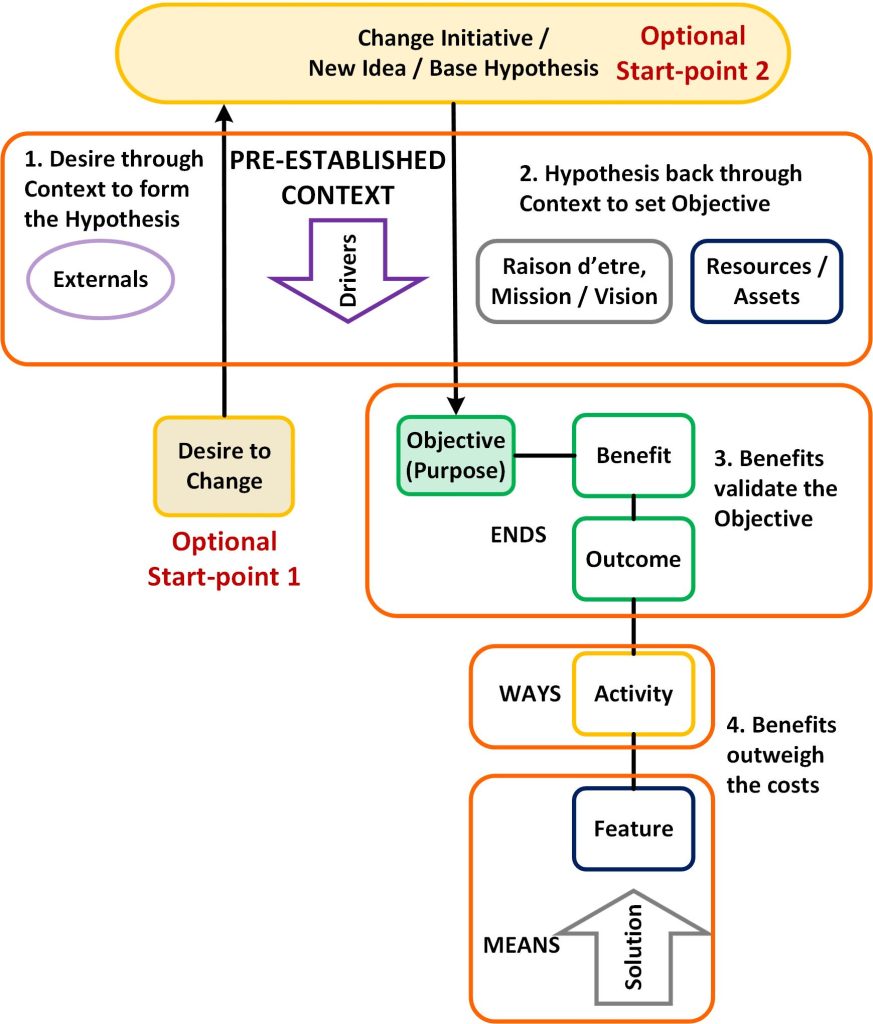
    The Idea Test process diagram

    The Idea Test is a way of testing new ideas against your strategy, goals and context. Before running away with a brilliant new idea, it needs to be checked to see how good it really is and how well it fits with who we are and what we do. It contains three checks to take us from hypotheticals to practicality.
    First, we have to understand the context in which we operate.
    Choose to change – A new idea, Base Hypothesis. At this stage, this is probably a loose statement of, “Why don’t we…?”
    First filter – test the Hypothesis against the context to see if it’s relevant and feasible. Should we do it, can we do it?
    Turn the Hypothesis into a Goal. “Why don’t we do X?” becomes, “We will do X, because…”
    A Goal / Objective is something with purpose. Start with the end in mind. Then optimise the value of the goal. Determine the benefits required, expected.
    Second filter – do the benefits validate the objective? Is your grand plan sensible? What’s it worth and who gets the value?
    Next, plan to realise the ends. You want to do it, now work out how you are going to do it.
    Third filter – is it practical and economical? Do the benefits outweigh the costs? Do you have a rational and sensible solution that will actually work in practice?

    Practical Tools

    This is where practical tools come in. If you can program as much as possible into the decision making processes then you save thinking time that you can put to better use.
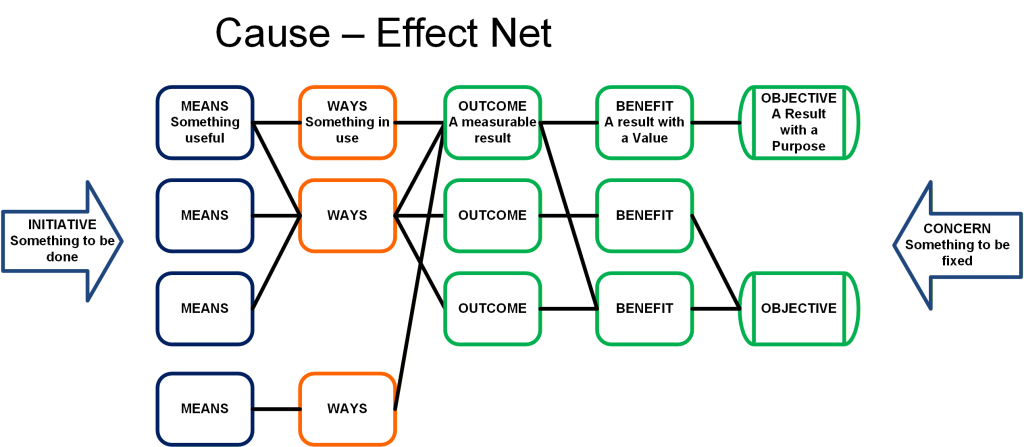
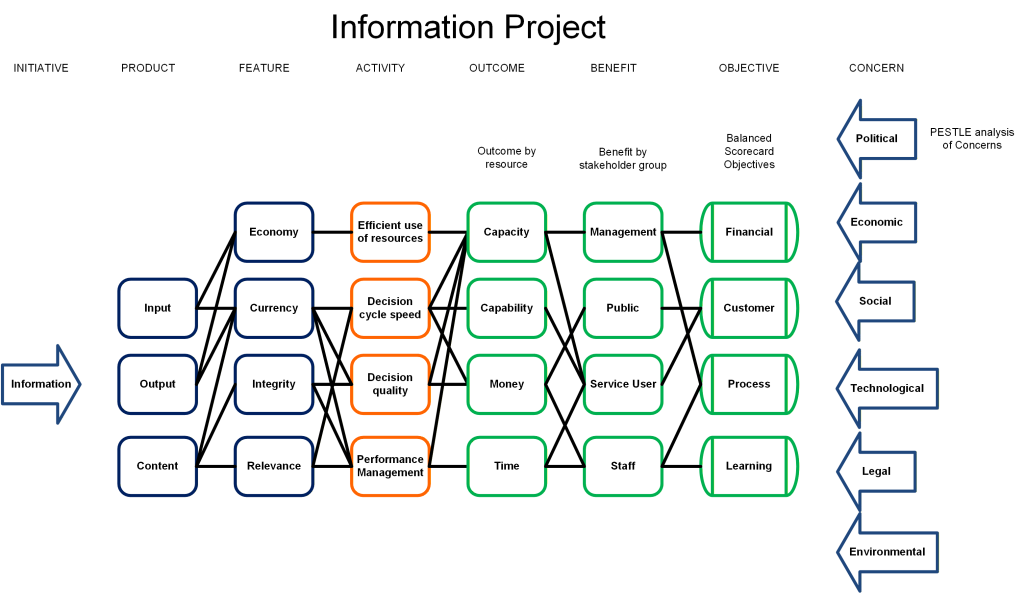
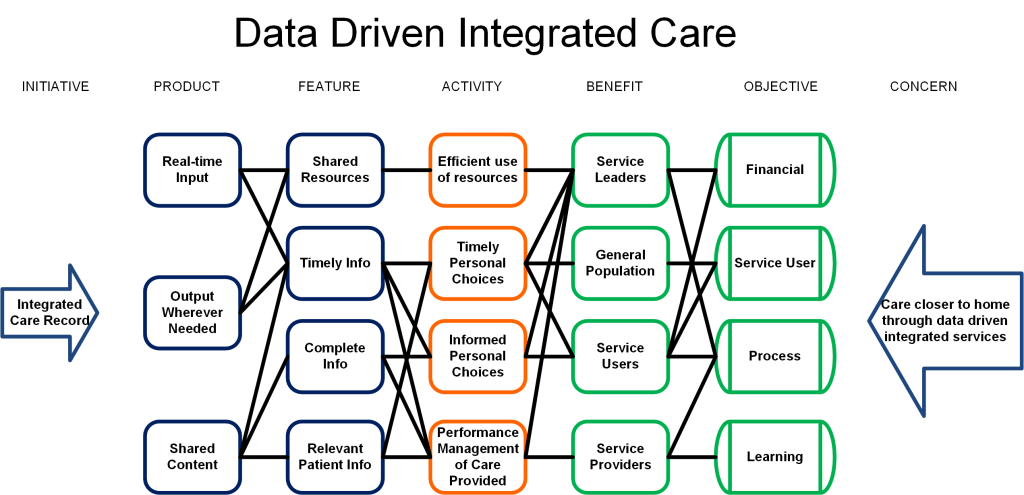
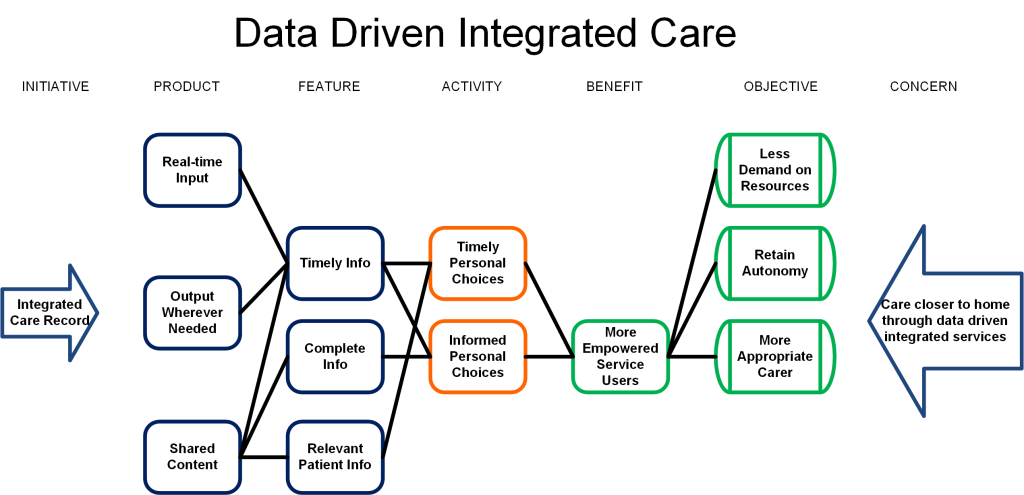
    One of the best practical tools is the Benefits Dependency Network. It is one of the key tools in the Benefits / Value arena. It shows the chains of cause and effect between what you use, do and want, i.e. between the means, ways and ends.

    In the Sprint you work towards creating the product increments, the capability that serves your purpose. You make the Means that serves the Ends. Benefits-led Agile is the approach that governs the ideas selected to feed this line.
    If new capability is discovered then we have to check that it’s useful. New Means may give us new Ends, a new Objective. So you test the idea, select or discard the Objective and move on.
    The BDN sets the strategic boundaries. It determines the limits of what’s desired and the scope of the solution. The Agile development is the tactics that control how the strategy is delivered.

    Requirements capture

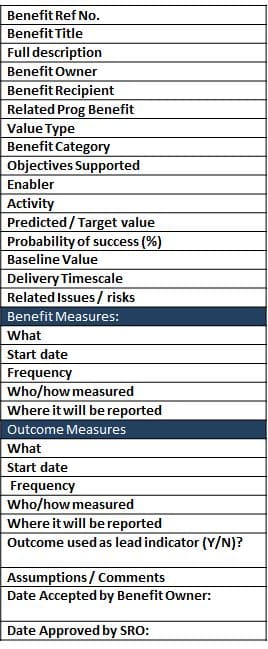
    Benefit Profile headers

    Scrum and Product Backlog has an assumption that the Product Owner has already done the analysis to select the best product increments to go in the Backlog. What have they used to make their MoSCoW selection? Where is their sense of proportion?

    The Benefit Profile form has a lot of headings and can look intimidatingly methodical (or just plain boring) at first sight. It works well when everyone remembers that the tool should fit reality and we don’t force reality into the tool. It’s not so much the detailed list as the things that go into it. They are cultural and fit the enterprise in question.
    The aim is to get the right thinking into the requirement, “I want these results (i.e. benefits) and I think this piece of functionality (product increment) will deliver them in the context in which I operate.” We phrase the requirement as Ends from Ways from Means, starting with the End in mind. Having drawn the BDN, we already know what we want (at a high level) and how the connections work. This form puts a bit of rigour and detail into the requirements.
    It gets us away from the instant answer of, “I want this solution, the reasons are self-evident but hard to express”, “It’s a no-brainer, I just can’t put it into words”.
    By describing each item in the Product Backlog using the same form and process, we can compare our options in a rational way by seeing their value relative to each other. The cultural context of the enterprise will have its own significant impact here. Some groups will go totally anal in the detail they complete. If that works for them, fine. Others will be fast and loose. Again, it’s whatever works. Where both types of group gain from the same process is that they’ve filled in the boxes in the form, in the right order, using a rational mindset and so have both raised the quality of the choices they make.
    Put rationality into MoSCoW
    Use the Benefit Profile to capture requirements:
    • Who’s it for?
    • What do they want to see happen?
    • How big a deal is it?
    Fit the tool to reality, make it work in context
    Choose Ends from Ways from Means

    Things to watch

    Preference for action, something must be done. This is something. We must do it.
    Incubators, great so long as you resource them properly and let them fail effectively if they have to. Know when to pull the plug and don’t blame the failures. Don’t even call them failures.
    Effective failure means you don’t bet the farm. Have a position to fall back on if you have to.
    Benefits-led Agile, being rational but not rigid, keeps your tactical Sprints within a strategic wrap.

  • The Biggest Barrier to Change

    Management workshops and discussion boards often ask what gets in the way of successful change. Typical replies say that Barriers to Change are:
    • Money
    • Senior sponsorship
    • Individuals’ resistance to change
    What’s missing here? How about, “It was a dumb idea to start with”?


    There’s a presumption that the selected change is the right thing to do but things get in the way of its successful implementation.
    Let’s not criticise the principles of Change Management by complaining that it doesn’t do something that it’s not designed to do anyway. I wouldn’t say that because my car lacks wings it’s a lousy plane. Change Management is there to deliver a choice that’s already been made. Its methods and tools aren’t designed to select a good change in the first place.
    Kotter’s steps to successful change begin with ‘Start with a sense of urgency’. It’s a matter of getting the right people motivated to act to deliver your vision. It assumes that your change is a good thing. Other models take a step back to consider the present state of affairs. Kanter says, “Analyse the organisation and its need to change”. Morris and Raban say, “Surface dissatisfaction with the present state.” Other guides to Change Management follow the same theme.
    None of the popular ones I’ve seen begin with anything like, “First, pick a really good idea”. Maybe if we saw that the selected change:
    • Isn’t feasible
    • Destroys value
    • Isn’t the best option
    • Is for the wrong people
    • Isn’t the sort of thing that we do

    Then maybe we could weed out the bad changes before they cause too much harm. Picking a good thing to do in the first place might also pull down some of the traditional barriers of money, sponsorship and motivation. It’s much easier to motivate someone to implement a good idea than a poor one.
    So what’s the step before Change Management? Von Clausewitz summed it up as the Selection and Maintenance of the Aim. APMG Managing Benefits calls it Starting with the End in Mind.
    An objective is a result with a purpose, “We will do X because…”. Even if it’s implicit, there has to be a sensible and understood ‘because’ behind the things you choose.
    A benefit is a result that a stakeholder perceives to be of value, we see who it’s for and what it’s worth to them. Then we can see if the benefits add up to make the objective worthwhile.
    Having a clear understanding of your objectives and benefits before you commit to change raises your chance of success. Confirming that understanding, testing your Big Idea, raises it even more.
    For more on how to do this, see The Idea Test.

    References:

    Kotter 1996
    Kanter et al, 1992
    Morris and Raben, 1992
    Von Clausewitz, On War, 1832
    APMG Managing Benefits, Jenner, 2012

  • Bored with Benefits

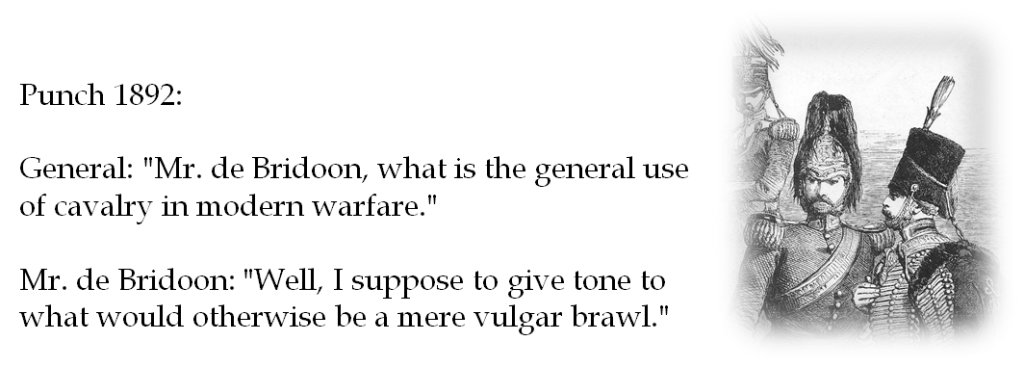
    Victorian Punch cartoon, "The use of cavalry"

    It’s time to move on. I can’t walk into a meeting nowadays without someone mentioning ‘Benefits’ and the thrill has gone.


    To all my Benefits Management colleagues and peers, I’m sorry but while we’ve not pitched our services high enough, the job you have now is about as good as it’s going to get.

    To everyone else, tagging benefits onto your projects is better than nothing, and I appreciate the effort. But it’s not really the whole answer to what you need.

    I don’t want to Realise Benefits anymore. I want to do something bigger than this. I don’t want to draw Benefits Maps. I want to draw Campaign Maps.

    The use of Benefits Management in modern business is to lend an element of rationality to the exercise of power.

    Frankly, it’s not good enough. Power is being exercised and all I seem to do is lend it a little air of rationality, usually long after the decisions have been made.

    The concentration on benefits is better than what we had before. But it’s only part of the story. What we have now is an emphasis on benefits that are rarely strategic, lots of piecemeal rewards that don’t add up to a strategic whole. Too many people think that Benefits are now the treats you give your stakeholders so they will play nicely with each other. The ‘Benefits-Led Organisation’ is likely to be working towards a shopping list rather than a set of strategic objectives.

    “…errant consilia nostra, quia non habent quo derigantur…”

    Our plans miscarry because they have no aim.

    Lucius Annaeus Seneca

    When Seneca wrote this two thousand years ago, his readers probably muttered, “Non stercore, Sherlock.” The problem is hardly new. We don’t put the right effort into our strategy to begin with. It’s time for Benefits Management to raise its game. I want to move on from Benefits Management to Strategy Management. We should all be in it for the strategy, not the benefits.

    Benefits Management as a method supports the better delivery of strategy. The tools and techniques are as valid for the whole organisation as for a single project. I just need people higher up the food-chain to take an interest.

    If you are a leader then take a moment to think about the science as well as the art of leadership. Consider what a little more rationality could do for you.

    If you’re a Benefits Manager then it’s time we got our heads together and raised some awareness of what we can do for our leaders.

  • Business Benefits with Value

    Picking ‘Good’ Benefits

    Rather than concentrate on the methodology, this page describes the output of Benefits Management. The processes, tools and forms are there to help you produce good benefits. They are not ends in themselves. Instead of getting bogged down in the paperwork we must understand what we actually want to achieve.


    First, we have to agree what a benefit is.

    A benefit is a result that a stakeholder perceives to be of value.

    The key points are stakeholder and perception. Who is the specific stakeholder under consideration? Is it patients in general or a Hospital Trust’s Finance Director? What sort of things do they perceive as valuable, improved clinical outcome, a better experience or hard cash in the bank?

    The programme’s objectives can be viewed as the SRO’s benefits. The SRO is the programme’s primary stakeholder. Their objectives are the results they perceive to be of value, the reasons why the programme must go ahead.

    Within the programme, good benefits start from good objectives.

    Good Objectives

    The purpose behind any course of action has a direct and significant effect on the way it is undertaken. The reasons why affect the ways we go about things. The objectives we choose validate the action we take so it’s vital we start with the right objectives:

    Programme / project objectives must relate clearly to the organisation’s business drivers and strategic objectives

    Objectives should be SMART and stretching, don’t de-scope into something short-term or easily measured

    Objectives must be strategic. “We will implement on time” or “We will work well together” are given statements of how the programme will operate, not valid descriptions of what it will achieve

    Keep to a few key objectives. Too many are unmanageable and will conflict with each other.

    Good Benefits

    Benefits provide the evidence that our objectives are being met and our programme justifies its existence:

    Benefits are identified up-front (at least in high-level terms). They are why you are doing the programme, not why you did it.

    Benefits are tightly linked to objectives, if not then the programme is being run for the wrong reasons

    Benefits are not simply treats to win stakeholders’ commitment

    Describe the benefit in verbs; improve, reduce, stop. It gets us away from picking project deliverables and functionality

    Each benefit has an Owner who is responsible for its delivery

    Each benefit has one Recipient, the stakeholder or stakeholder group who can say that the benefit has been realised. You can’t prove a benefit that is spread over multiple stakeholders

    Benefits should be SMART and stretching, don’t de-scope into something short-term or easily measured. Set a target or predict the value for a successful benefit

    Set a baseline. If you don’t know where you started from then you can’t say how far you got and you can’t prove it was worth the effort

    Keep to a few key benefits. Each one will have a significant amount of work behind it. A hundred benefits may look good in a business case but they’ll never happen.

    If you’re not sure of a benefit, keep asking the ‘so what?’ questions until you know who it’s for and why it’s important

    Look out for the ‘usual suspects’. Make sure the benefits are appropriate for your programme. Not every project has to improve patient care.

    Iteration works, the third pass will look much better than the first one.

  • Cargo Cult Map

    Just because it looks like one doesn’t mean it is one

    Are your networks fit for purpose or are you drawing them out of superstition?

    Child's puzzle, whose kite is whose?

    Variety is (not always) the Spice of Life

    Cargo cults were first seen in the Pacific after WWII. Islanders watched US forces build airstrips. Then planes arrived full of cargo. The war ended, the airstrips closed and the planes stopped coming. Logic suggested that if you build airstrips, the planes will come. And so the islanders copied as best they could in the vain hope that they could attract new planes with more cargo.

    A quick search on “cargo cult management” will bring up a raft of articles on how the same logic gets applied in business circles. We make assumptions and copy without a proper understanding of the original situation. And then, like the poor old Pacific islanders, we wonder why the planes won’t come.

    A few years back I worked on a programme that introduced BM into parts of the NHS. Within a couple of months we saw that people were drawing their Benefits Dependency Networks in a variety of ways. Some of this was due to the tools they had. Visio obviously offered more depth than filling cells in a spreadsheet and the diagrams would look very different in style, if not in content. But it wasn’t just the tools. People adapted the BDN to their own understanding of the method and their personal preferences. At the time I viewed it as the evolution of local dialects, a natural progression and not a major issue. Indeed, possibly a good thing.

    Now, I’m not so sure. Maybe natural selection isn’t yet happening as it should and the weak are thriving. I’ve started to come across a few BDNs that can’t perform their function. Ones where the links are all right angled connections that overlap so it appears that everything in one column connects to everything in the next. Others have objectives in the middle so the chain of cause and effect isn’t rational and the cart is pulling the horses. There are people out there who are mistaken about the quality of their method and the subsequent benefits they choose to deliver. They are not doing quite as well as they think they are.

    The APM specific interest group wrote a pamphlet on embedding BM in the enterprise. I think it’s time we all worked on embedding good BM in the enterprise. I don’t want to go as far as mandating one methodology. I’ve got my own (superior, naturally…) way of doing things and I don’t want to give it up. Many other people will feel the same way. However, I think there’s scope to use our formal and informal networks to share good practice on the fundamentals. When people work in a vacuum their practices change over time without anyone checking if they are still valid. Before long the minor dialect change risks turning into nonsense that’s performed more out of superstition than business value.

  • The Decision Guide

    Decision Guide

    A Guide gets you through difficult territory. They won’t pick your destination, though they may make suggestions. “This summit has a better view.” “We can get to that destination in half the time.” You are in charge of where you want to end up.


    The Guide won’t carry your bags. Your party does the heavy work. What they will do is lead you by the best route to where you want to be. Their knowledge of the area and experience of previous journeys means they can avoid the pitfalls and dead-ends and select easier and quicker paths.

    In business terms, that’s what a Decision Guide does. It’s still your business, you understand what you are about, you make the decisions on what you want to change and your people do the work to change it. I bring the subject matter expertise in making business choices and the experience of seeing how it’s been done before.

    My role is to lead you through the process of making those decisions so that you choose the best option and take the optimal route to business success. I use Benefits Management to help you choose the right thing, for the right reasons and see it delivered.

  • Down the Market

    Imagine your programme is pickling a shark. Do you know what the shark is worth?

    This is one of those analogy things so please suspend your disbelief and work with me. It should all make sense in the end. I’m going to apply some ideas from the World of Art to the world of intangible benefits, the ones that don’t result in an easily counted bag of cash.


    As a Benefits Manager, part of my job is to work out if / why Plan A is the best use of our scarce resources, what makes it better than Plan B and all the other plans we could spend on. This isn’t helped when there is no common understanding of Plan A’s added value, how much its benefits will outweigh its costs.

    Part of the reason we struggle to value any intangible product / service is because we don’t think about the market where it’s bought and sold. Our programme is going to create something of value, a solution that realises benefits worth more than its costs. Think of it as our Masterpiece. It’s a work of art, not a commodity. Its value will be set by a select few stakeholders in the art market, not by hundreds of traders in the stock market.

    It’s bespoke, complicated and unique. Other programmes’ outcomes may be similar, but they are not exactly the same. It’s not so much one barrel of oil out of millions, it’s more like Damien Hurst’s big dead shark in a tank of formaldehyde. It is considered an exemplar of artistic skill (by the people who like that sort of thing). It’s made from relatively cheap materials, so there’s no scrap value worth talking about. If it succeeds, then it’s a priceless art. If not, it’s worthless junk. It’s original and outside any established school or style so there’s no benchmark against which to compare it.

    Like the dead shark, it could be worth £millions, but it will depend on who you ask and how you ask them. Pricing your programme’s intangible benefits is like selling a work of art, so let’s look at our stakeholders in some different art markets. Our market for the Masterpiece consists of four stakeholder groups:

    • The one client who wants to buy the Masterpiece and has the funds to pay for it
    • One or more suppliers who want to build the Masterpiece
    • Consumers who will use the Masterpiece or the system that delivers it (e.g. our staff and their customers)
    • Influencers who have opinions about the Masterpiece and the alternative ways to spend the money

    The value of the Masterpiece will be determined by these four groups. It’s going to sit at the balance point between each group’s understanding of value and their influence / power over the others. The market is where they come together to set the price. So, from an art world point of view what sort of markets could apply here?

    The Private Commission

    This deal is done in private. The client wants something personal and has money burning a hole in their pocket. They find a supplier (artist) they like, and a deal is done between them. No-one else is involved. There are no consumers to work the system between client and supplier and no influencers to affect the price. There is only one benefit, the client’s happiness. The client says that their satisfaction is worth the price they paid.

    The Art Gallery

    This time, the client may not have a single supplier in mind and goes shopping for an artwork. The consumer is the gallery owner who introduces artists to buyers, brokers the deal between them and takes a commission from the sale. The supplier is our artist with an established reputation for high-class modern art. Influencers are a small community of gallery owners, art critics and competing art buyers with money to burn.

    If it’s not a private sale, say the client is buying something to put in a public gallery, then influence expands to people with an opinion on how the client is spending their public money. Or at least, to those people whose opinion the client cares about. The client acts in anticipation of what these stakeholders will think and do.

    The client still decides the value, but that decision is heavily influenced by their understanding of the competition. “I want it because I want it. If I don’t pay £££s, then I will lose it to someone else. I’m comfortable paying £££s. And if it’s not my money, I think I can justify my decision to the press, public, auditors, etc.”

    The Online Auction

    This time, the sale has been advertised world-wide so many more influencers know the art is for sale. Everyone can see the value change in real time as the bids come in. The client still decides the value, but this time they’re better informed. “I paid the market rate for it (which was a lot) but I’m comfortable paying that price.” Or “Bidding stopped much quicker than I expected. I got a bargain…or maybe everyone else knows something I don’t.”

    The Street Market

    Our supplier, the artist decides to ditch the bourgeois art world and take his work to the people, so he hires a market stall for the day and sets up his masterpiece.

    On a busy Saturday there are lots of people passing by who will see his work, but no motivated clients with huge budgets looking for art, maybe the occasional tourist with a bit of spending money. There are certainly lots of influencers around who are happy to voice their lay person’s opinion on the merits of modern art and this piece in particular. Assuming it actually sells, the price will be nowhere near what the gallery could have got.

    Even though we’re talking about the same work of art, the different markets involving different stakeholders come up with vastly different values. The same applies to the intangible benefits of any project / programme. The stakeholders, their beliefs, needs, expectations, resources and power all affect the value they put on the results.

    The Programme as Art

    Very few Benefits Managers get brought in at a programme’s inception to advise on the wisdom of the investment. Usually, the core decision has been made long before the costs and benefits get analysed. The programme sponsor / Senior Responsible Officer, the client in my story wants something big and striking, they’ve cleared the space for it and they’re ready to spend. They’re toying with buying the business equivalent of a pickled shark and want to know if it’s worth the asking price.

    What market forces will affect their decision? Think about the context of the programme and the stakeholders involved, its governance and evaluation arrangements. Who are the four stakeholder groups and how do they interact to determine the programme’s value?

    It could be a privately commissioned piece where the sponsor has a requirement to meet and the cash to spend. They make a deal with the supplier and don’t involve anyone else. They decide if it’s all worthwhile. This is only going to happen for the small stuff within spending limits. Unless you own the company, there will be rules to stop you making big private deals.

    A gallery sale involves the supplier’s sales team in bringing sponsor and supplier together, “What you need is a big dead shark. And we know just where we can get you one.” Once again, the sponsor sets the value. This time though, including the sales team will add a bit to the cost and trim the value.

    Most likely, it will be an auction sale, a job put out to tender within procurement rules. More stakeholders are involved, but they’re all professionals and specialists. They may set boundaries, “You cannot spend more than this. That supplier is not acceptable…” Governance and evaluation influence the choices made and so affect the value. It’s no longer the sponsor’s sole opinion.

    The street market may be a supplier with a solution in search of a problem, “I’ve invented this wonderful app, who wants to buy it? Anyone?…” More likely, it’s supplier and client working together to spread the cost, risk or blame for a choice they’ve already made. “See, it’s not just us. We showed it to everyone and lots of other people thought it was good and wanted a bit of it.”

    At the end of the day, the purpose of Benefits Management is to lend an air of rationality to the exercise of power, and all benefits are a result that a stakeholder perceives to be worthwhile. When it comes to the intangible stuff, there are no simple right or wrong answers, and stakeholder perception is everything. We bring in the rationality by considering the key stakeholders, how they interact and the context in which they operate together, i.e. their market. And hopefully, we get them to agree on a reasonable value for their benefits.

  • Educate, Agitate, Organise

    Motivating change

    [This first appeared as a Guest Blog for Sayers Solutions, May 2013]

    I was going through the family heirlooms and found my dad’s old Trade Union badge blazoned with the motto, “Educate, Agitate, Organise”. It’s a phrase that I haven’t thought about for a long time. It’s good though, when you look at it. If you want to get something changed, this is how to do it, summed in three words.

    Educate – “Did you know that…?”

    Agitate – “Don’t you think we should…?

    Organise – “Then let’s go do…”


    There you have it, how to lead change in three words (and an awful lot of work in the background, glib phrases on their own aren’t enough).

    Educate

    Do you have a message you want to get across? Is it something short, meaningful and bound to make an impact on the people you tell? If it isn’t, can you re-phrase it so it is? Consider the things you don’t know. Your customers and colleagues have their own messages they want to tell you if you give them the right opportunity.

    You can’t change everything at once so look to the benefits. See which change has the biggest impact and who gets the most out of it. Check that it’s feasible and the benefits easily outweigh the costs. That means measuring them and knowing your present baseline. Like I said, an awful lot of work in the background, but it’s best to put the effort in at the start and do something worthwhile. 

    Agitate

    Having chosen to make a change, you’ve got to motivate people to go along with you. You need a compelling story that appeals to your audience. Where you have more than one audience you may need more than one story. But you have to maintain your integrity here. You can’t go about telling everyone what you think they want to hear. Apart from the fact that it’s just wrong, they will catch you out eventually. 

    Organise

    Now comes the dull, hard part. You’ve chosen your Big Idea, everyone’s raring to go, now you’ve got to sort out the practical stuff of who does what, when. There are libraries of books on planning so I’ll not try to cover it here. I will say though that you need to invest more in the change than you do in the hardware. Projects often fail because they spend a lot on the new kit and then try to do business change on the cheap, squeezing it into people’s day-jobs instead of investing in it properly.

    One final thing, don’t treat these three as a sequence of events. Look on them more as a loop. As you learn lessons, re-educate. Agitate constantly, keep up constant communication. Organise flexibly as circumstances change around you.

    So far I’ve failed to find out who invented the phrase. It’s got roots in Victorian socialism, but I haven’t traced its author. Could someone please tell me? I think they deserve a bit of acknowledgement.

  • Embed New Ideas

    From Flavour of the Month to Spécialité de la Maison

    You’ve discovered the ultimate solution, the answer to all your business problems, the business method you’ve waited your entire professional life to find. How will you get your colleagues to take it up? How will you make sure that it will be going strong next year? How will you take it from ‘Flavour of the Month’ to ‘Spécialité de la Maison’?


    Selling the concept

    Everybody says that senior level sponsorship is essential, which it is. So first of all, you’ve got to sell the concepts to the people who matter, the ones who hold the purse strings and who permit you to proceed. Your Method is full of rational and logical value. You are convinced it’s good, so it’s hard to see why no-one else is. Sadly, they haven’t given it the thought and study you have and they don’t always see things your way. You will have to pitch your proposal to them. Even the most un-commercial, egalitarian organisation will have some element of internal competition. You will find yourself competing for senior level sponsorship with all the other initiatives that are vying for their attention, time and budget. No matter what rational value you can bring, you will lose to the person with a more attractive offer. There isn’t space here to take you through all the relevant sales techniques so get the help of your sales and marketing colleagues to make an offer no sponsor can refuse.

    Credibility is a common problem

    People will not take the help you offer if they have no confidence in it. Any successful ‘Head Office imposed business method’ requires credibility to survive and this isn’t easy. Maintaining the Board’s interest and approval is an on-going job. Boards are naturally fickle and it can be safely assumed that any sponsorship at Board level will be fleeting. They are soon distracted by the next big thing or the recurring problems of daily organisational existence.

    If your senior sponsor tells you their work is now done and the Method has been absorbed into the corporate bloodstream, then it’s as good as dead. Line managers will lose interest and it becomes the responsibility of the ‘Resident Expert’. This person is more likely to be appointed for their availability, not their skills. They will be seen as being out of the daily grind, very much a ‘them’ not an ‘us’, the woman / man with a clipboard from head office. Relationships spiral downwards, with poor results and a general desire to back out of the whole process.

    So, you have two audiences to engage, the Board and the end-users.

    Board-level commitment

    The people who tell you that senior sponsorship is essential will also tell you that the way to their hearts is through their pockets. All you have to do is get the promotion of the Method into their personal objectives and they’ll drive it for you. In practice, this will be short-term and output-focussed and won’t get you very far. Your Method may be a work of genius that will change the enterprise significantly but it’s going to be a low priority in any executive’s KPIs. Given personal objectives of, ‘Raise sales in Asia by 10%’ or ‘Ensure all staff complete Form 37a’, which one is going to have the higher reward and so motivate the executive?

    The way to maintain Board-level commitment to something new is to embed its tools and techniques into the standard operating procedures that the execs and seniors use. For example, if you are promoting Benefits Management then make sure that the standard business case template contains a basic Goal Model Map or Benefits Dependency Network. Include a stakeholder analysis in every options appraisal. Have a Benefits trained facilitator aid their strategic planning discussions.

    Using the tools at Board level will encourage, if not mandate their use elsewhere. If a Director has to report to her colleagues using these tools then she will expect her staff to support her by using the same tools.

    Practical application

    So, the Board are on board, how do you bring the rest of the organisation along with them? The end users of the Method are the people who have to make the changes to their working practice and live with the consequences. They are going to be busy and under pressure to deliver. They may be too busy fire-fighting to recognise an extinguisher when it’s offered to them. You cannot expect their instant and enthusiastic cooperation. You will have to convince them of your great idea first, which brings us back to credibility. Dealing with the credibility issue means the Method has to attract the right people to champion the cause and spread the message to their colleagues. In branding terms it is affinity marketing, building on the strengths of both sides.

    The actual people who become Champions will obviously depend on the organisation in question. In general terms, we are looking for positive role-models. Often this means respected peers rather than senior staff or head office functionaries, people with a good reputation who lead opinion amongst their colleagues. Respected peers usually have very busy day-jobs which they will not or cannot leave for a permanent role specialising in the Method. They may be available for short-term secondment though.

    If the organisation has a fast-track promotion route or leader development scheme then include a secondment as one of its stages. This gets the bright go-getters involved and they take the skills with them as they rise to the top.

    The downside of this secondment process is that the churn of people passing through risks corrupting the Method. Anyone on a short secondment will still be learning as they leave for their next assignment. There won’t be much improvement over time because all the lessons learned will be from people reinventing the new starter’s wheel. If they are the only ones available to train their replacements then the Method will deteriorate through that well-known party game of Chinese Whispers.

    Someone is going to have to provide an element of stability at the centre of the seconded group. This Subject Matter Expertise will provide the common core training to the Champions. It will assure the quality of their work to ensure that everyone is applying consistent best practice. It will support them with higher level skills and techniques to resolve the complex cases. It will collate and analyse lessons learned and look to improve the Method over time. The Champions will depend on them and so have a good incentive to see the right Experts are selected and supported by the organisation. The Experts get to work with the brightest and best (and most demanding). All in all, a much more positive outcome than the traditional Resident Expert will achieve.

    So, for the successful implementation of the Method, the best balance is to set up a core group / expert who can maintain and enhance it and to place a broader team of respected secondees around them to champion the Method across the organisation.

    Only the largest or most specialist organisations will have the manpower to staff such a centre of excellence fully. The credibility issue is so important that the Champions have to be local, known and respected. However, there is an argument for out-sourcing the subject matter expertise. Most of its skills will be reasonably generic and will be improved by wide experience. The Experts won’t need to know too much about organisation-specific work-flows and personalities. They will need to know the Method inside out and how to apply it appropriately within your organisation.

    An external Method hub will bring a breadth of experience and best practice. It also encourages an element of benchmarking competition between members and raises the bar for them all.

    Each organisation’s culture, context and budgets will determine where the centre of excellence will sit. It could be in-house, a shared service between similar organisations, a bought-in consultancy or a combination of the three.

    Business Method Centre of Excellence

    Finally, remember that nothing lasts forever. You’ve got your Method beyond being Flavour of the Month and into active use. It’s become ‘the way we do things here’. By all means, keep it going while it’s adding value but recognise when to stop. Don’t let it get in the way when something better comes along.

    Summary

    The core message boils down to:

    • You have to sell the concepts
    • Credibility is key
    • Senior sponsorship will not last unless tools are established in the processes that the seniors use.
    • Credibility in the workplace will depend on Champions. These should be respected peers or high-flyers seconded into the Method team
    • Champions will need Subject Matter Expertise to support them and to maintain and enhance the Method
    • The location of the Subject Matter Experts will depend on your organisation’s culture, context and budgets
    • Don’t keep pushing the Method when it’s stopped adding value