
The Idea Test
Hypothesis testing is a way of testing new ideas against your strategy, objectives and context. Before running away with a brilliant new idea, it needs to be checked to see how good it really is and how well it fits with who you are and what you do.
No-one enjoys getting their homework marked, and the same applies with any business assurance process. By the time you hand over your business case to be sense-checked by colleagues, you will already have invested a lot personally, as well as financially. If it’s going through a formal approval process, you really don’t want to be rejected. If it’s the subject of an audit, then it’s probably too late to correct anything and your reputation will be defined by their findings.
Even when all goes well and assurance re-assures you that you’re doing things right, there’s always that period of doubt and anxiety until you get the OK.
If re-assurance is someone taking away your worry after the event, then ‘pre-assurance’ is what you do to take away the cause for worry in the first place. Pre-assurance is all about testing your decision before you pass it over to someone else for comment.
The Idea Test is one way to pre-assure your initiative. It’s a way of testing new ideas against your strategy, objectives and context. Before running away with a brilliant new idea, it needs to be checked to see how good it really is and how well it fits with who you are and what you do.
The Idea Test contains checks to take you from hypotheticals to practicality. There are four filters for your investment decision to pass through or fail:
- First filter –If you’re looking for change, but you don’t know what it should be, pass your desire to change through your business context. Focus on something that demands action and find your new idea or hypothesis.
- Second filter – pass the Hypothesis back through the context to see if it’s relevant and feasible.
- Third filter – test the Objective against the benefits and detriments to see if it is desirable.
- Fourth filter – test the Benefits against the Plan to prove it is a worthwhile use of resources.
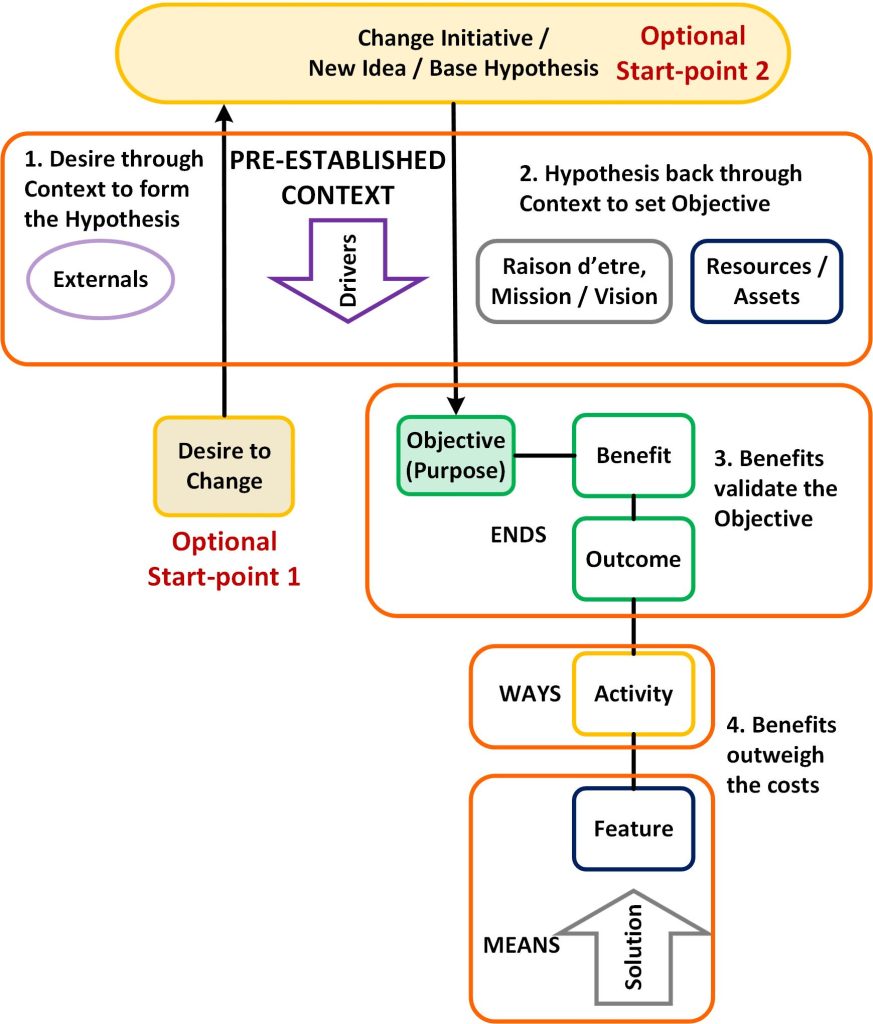
The Idea Test
Pre-established Context
To begin with, you have to set the scene, to understand the context in which you operate. If you don’t know where you are, you can’t be sure where your change will take you.
Who are you, what do you do, what do you think? Understand the purpose and culture of the organisation. What’s your Vision and Mission, your raison d’être? What drives you from outside? Know the externals you work with (competitors, customers, suppliers, partners, society). What resources do you have, physical and intangible, kit and people?
Optional Start-point 1, Desire to Change
Then you can choose to change. At this point, you may not have a particular change in mind. You just know that you can’t stand still, something must be done. Start here if you’re looking for inspiration.
First filter – pass your desire to change through the context to see where the opportunities or gaps lie. Use the Context for some horizon scanning. “What’s happening out there?” “What could be better…?” “What should we fix…?” Try some SWOT analysis. If you don’t already have a Problem Statement, this is where you can create one.
Optional Start-point 2, the Base Hypothesis
The first filter takes your vague desire to change and turns it into a Base Hypothesis, “Why don’t we…?” “Wouldn’t it be good if…?” Often though, someone’s already had the idea and you start here with the Base Hypothesis. If you’re lucky, it’s come from a workshop of rational experts. If not, it’s probably something your boss heard at the Golf Club. Either way, it needs to be checked.
Second filter – pass the Hypothesis through the context to see if it’s relevant, appropriate and feasible. Will your new idea be good for your business? Do you have the capacity and capability to do it?
Are you comfortable that it fits with the sort of people you are? A silly example – you’re the local Temperance Lodge and you need to raise funds. Someone suggests opening a members’ bar. It really doesn’t fit that well with your mission. A more sensible historic example – the supermarket Tesco was basically a giant grocer. Then someone suggested selling financial services. At first sight there’s no connection but thinking about it, Tesco has a huge customer base and knows a lot about their financial state. The company’s purpose is to make profit. The idea made commercial sense and Tesco Bank still exists.
Turn the Hypothesis into an Objective. Go from, “Why don’t we do X?” to, “We will do X because…” The ‘because’ is vital, even if it’s implicit. The purpose behind any course of action has a direct and significant effect on the way it is undertaken. The same applies for any project, the ends affect the means and ways. That’s why a few, clear, SMART objectives are crucial.
You have an objective, a result with a significant and agreed purpose. The next step is to establish the benefits. Most ‘Benefits’ you will see aren’t benefits at all. They’re system features or outcomes, it’s small, fast, painted in friendly colours… So, what is a benefit?
A benefit is a result that a stakeholder perceives to be of value
A benefit needs a stakeholder, someone has to see its merit. “What’s in it for me?” is a subjective judgement.
We use benefits as an aid to setting good objectives. It’s reasonable to expect that our objective will be something to do with bringing benefit to someone, even if it’s purely selfishly to ourselves. The moral and ethical issues can keep for another article. The key points here are a benefit needs a stakeholder, someone has to see its merit, and perception is crucial. “What’s in it for me?” is a subjective judgement. Like morality, issues of relative value, altruism and perverse choices can be left for another day.
However, the definition of benefit helps us define the things around it like outcome and objective. Get away from features and outcomes. It’s got to be perceived as being valuable, e.g. improving sales, reducing complaints, stopping costly processes, not improving network performance, reducing down-time and stopping legacy systems. Use a Benefits Map to plot the cause – effect links.

A Generic Benefits Map
Third filter – test the Objective against the optimised package of benefits and detriments to see if it is desirable. “If we do X, we will get Y, and we really want Y.” Is the Objective big enough to bother? Too often we do projects without a clear up-front understanding of what benefits they will deliver. ‘Build it and they will come’ is a gamble that maybe we ought not take.
Different stakeholders want different things. Work out who you are doing it for and what they perceive as being valuable. Who are the key ones who have a significant influence on the project? What business changes will they make for the project to be successful? “What’s in it for them?” How committed to success will they be and where do we want them to be? Are the benefits appropriate? “You’re doing this because it brings substantial benefit to the right people”.
Knowing if the benefit will be substantial means putting a price on it. Your benefit may not be cash in the bank, but you still need to know what it’s worth, what you’d be willing to pay if you had to. Later, you’ll have to show that the benefits will outweigh the costs.
Now you have a good feel for what you want, plan to realise the Ends (Objective, Benefits, Outcomes) through the best use of Ways and Means. This is where the Benefits Map comes in useful again. Mapping makes the links and dependencies clearer than tables in a business case. Your plan must include costs and risks so you will know the expense and the chance of success.
Fourth filter – Test the benefits against the costed plan. Is the cost (money, time, stress, lost opportunities) outweighed by the benefits? Will your Big Idea add value?
Test the benefits it delivers against the costs involved to prove it is a worthwhile use of resources. You know the chains of cause – effect from Means to Ends. The benefits you have selected are feasible and properly quantified. You’ve accounted for risk and dependency, so the chances of success are reasonable. All things considered; will you get a satisfactory return on your investment? If not, what can you change in the scope or funding to make it worthwhile?
When your idea has passed through the four filters you know that it is:
- Appropriate – it’s the right thing to do
- Feasible – the effort required is manageable and within your capabilities
- Worthwhile – benefits outweigh the costs and will satisfy the people you want to keep happy, (including you)
You’ve got the makings of a good idea and the start of a successful business case. Then all you have to do is plan, implement, manage, etc., the entertaining stuff…
The Idea Test was introduced to the NHS in England to support the NHS Change Day campaign of 2013. It was updated in 2024 to include the initial desire to change.