
Everybody likes a Maturity Model these days. It’s the management version of Top Trumps. So before you worry about how mature your enterprise is at doing stuff, here’s where you consider the stuff you choose to do in the first place. How good is the process around the business choices you make? Would you like to make it better or are you happy that your luck will continue to see you through?
With a score of 5 being perfection and 1 being, “I’m sorry, were you talking to me?” what would you score against these topics?:
- Depth and breadth of knowledge behind the decision
- Application of knowledge to the decision
- Stakeholder contribution to the decision process
- Decision cycle speed
- Giving direction
- Confidence in delivery
Where do you sit on the maturity scale when it comes to making business decisions?
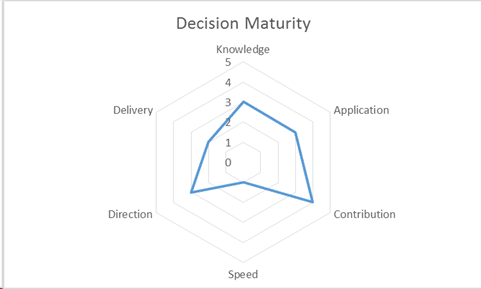
Where would you be on this chart? Does it give you pause for thought?
Waller’s Decision Maturity Model
Fives. Omniscience, omnipotence, alacrity and economy
Knowledge – You know all the relevant information that will inform your decision.
Application – You weigh it and apply it appropriately in making your best choices.
Contribution – All the relevant stakeholders contribute to the decision to the best of their ability.
Speed – Your decision cycle is minimised. Results are achieved as quickly as is possible.
Direction – You convert the decision to clear, concise direction that motivates your stakeholders to act towards a common goal.
Delivery – Stakeholders act on that direction to deliver your desired outcome in the most efficient manner.
Fours. On the upper slopes
You just about know it all. You meet very few surprises.
You use rigorous methods to apply what you know when making choices and you understand what the consequences will be.
You actively consult widely. Most stakeholders contribute to the decision to the best of their ability.
Your decision cycle is optimised with no un-necessary delay. You do not sit on decisions.
You give clear direction so people know what they must do.
Stakeholders act on your direction to deliver a satisfactory result within the tolerances you have set.
Threes. Middle ground
You are reasonably comfortable with what you know. You understand the situation better than most around you.
You apply what you know to your decision but recognise that you still have areas of uncertainty.
You have active contribution by some Stakeholders. The ‘usual suspects’ chip in with their ideas.
You have a recognised decision cycle and allow decisions to be reviewed iteratively, e.g. Plan, Do, Study, Act.
You put what you want into words that most of your people understand.
People mostly do what they should but you expect to make a few mid-course corrections when they stray from your path.
Twos. Mildly embarrassed by your performance
You know that you don’t know it all
There’s a nod towards strategy in your template Business Case.
You know you have some Stakeholders and you talk to your favourites.
You’ve missed the boat a few times and you know you’ve got to be quicker next time.
You think you’ve said what you want doing.
Stuff happens but people keep coming back with difficult questions about what they think they should be doing.
Ones. What problem?
“I didn’t get where I am by sitting around researching stuff.”
“Something must be done. This is something. Let’s do it. Why waste time on a Business Case?”
“I know what people want.”
“This creative stuff is an art, you can’t rush it.”
“You all know what to do. Carry on.”
“Does anyone here know what we’re meant to be doing?”