Management workshops and discussion boards often ask what gets in the way of successful change. Typical replies say that Barriers to Change are: • Money • Senior sponsorship • Individuals’ resistance to change What’s missing here? How about, “It was a dumb idea to start with”?
There’s a presumption that the selected change is the right thing to do but things get in the way of its successful implementation. Let’s not criticise the principles of Change Management by complaining that it doesn’t do something that it’s not designed to do anyway. I wouldn’t say that because my car lacks wings it’s a lousy plane. Change Management is there to deliver a choice that’s already been made. Its methods and tools aren’t designed to select a good change in the first place. Kotter’s steps to successful change begin with ‘Start with a sense of urgency’. It’s a matter of getting the right people motivated to act to deliver your vision. It assumes that your change is a good thing. Other models take a step back to consider the present state of affairs. Kanter says, “Analyse the organisation and its need to change”. Morris and Raban say, “Surface dissatisfaction with the present state.” Other guides to Change Management follow the same theme. None of the popular ones I’ve seen begin with anything like, “First, pick a really good idea”. Maybe if we saw that the selected change: • Isn’t feasible • Destroys value • Isn’t the best option • Is for the wrong people • Isn’t the sort of thing that we do
Then maybe we could weed out the bad changes before they cause too much harm. Picking a good thing to do in the first place might also pull down some of the traditional barriers of money, sponsorship and motivation. It’s much easier to motivate someone to implement a good idea than a poor one. So what’s the step before Change Management? Von Clausewitz summed it up as the Selection and Maintenance of the Aim. APMG Managing Benefits calls it Starting with the End in Mind. An objective is a result with a purpose, “We will do X because…”. Even if it’s implicit, there has to be a sensible and understood ‘because’ behind the things you choose. A benefit is a result that a stakeholder perceives to be of value, we see who it’s for and what it’s worth to them. Then we can see if the benefits add up to make the objective worthwhile. Having a clear understanding of your objectives and benefits before you commit to change raises your chance of success. Confirming that understanding, testing your Big Idea, raises it even more. For more on how to do this, see The Idea Test.
References:
Kotter 1996 Kanter et al, 1992 Morris and Raben, 1992 Von Clausewitz, On War, 1832 APMG Managing Benefits, Jenner, 2012
A Guide gets you through difficult territory. They won’t pick your destination, though they may make suggestions. “This summit has a better view.” “We can get to that destination in half the time.” You are in charge of where you want to end up.
The Guide won’t carry your bags. Your party does the heavy work. What they will do is lead you by the best route to where you want to be. Their knowledge of the area and experience of previous journeys means they can avoid the pitfalls and dead-ends and select easier and quicker paths.
In business terms, that’s what a Decision Guide does. It’s still your business, you understand what you are about, you make the decisions on what you want to change and your people do the work to change it. I bring the subject matter expertise in making business choices and the experience of seeing how it’s been done before.
My role is to lead you through the process of making those decisions so that you choose the best option and take the optimal route to business success. I use Benefits Management to help you choose the right thing, for the right reasons and see it delivered.
From Flavour of the Month to Spécialité de la Maison
You’ve discovered the ultimate solution, the answer to all your business problems, the business method you’ve waited your entire professional life to find. How will you get your colleagues to take it up? How will you make sure that it will be going strong next year? How will you take it from ‘Flavour of the Month’ to ‘Spécialité de la Maison’?
Selling the concept
Everybody says that senior level sponsorship is essential, which it is. So first of all, you’ve got to sell the concepts to the people who matter, the ones who hold the purse strings and who permit you to proceed. Your Method is full of rational and logical value. You are convinced it’s good, so it’s hard to see why no-one else is. Sadly, they haven’t given it the thought and study you have and they don’t always see things your way. You will have to pitch your proposal to them. Even the most un-commercial, egalitarian organisation will have some element of internal competition. You will find yourself competing for senior level sponsorship with all the other initiatives that are vying for their attention, time and budget. No matter what rational value you can bring, you will lose to the person with a more attractive offer. There isn’t space here to take you through all the relevant sales techniques so get the help of your sales and marketing colleagues to make an offer no sponsor can refuse.
Credibility is a common problem
People will not take the help you offer if they have no confidence in it. Any successful ‘Head Office imposed business method’ requires credibility to survive and this isn’t easy. Maintaining the Board’s interest and approval is an on-going job. Boards are naturally fickle and it can be safely assumed that any sponsorship at Board level will be fleeting. They are soon distracted by the next big thing or the recurring problems of daily organisational existence.
If your senior sponsor tells you their work is now done and the Method has been absorbed into the corporate bloodstream, then it’s as good as dead. Line managers will lose interest and it becomes the responsibility of the ‘Resident Expert’. This person is more likely to be appointed for their availability, not their skills. They will be seen as being out of the daily grind, very much a ‘them’ not an ‘us’, the woman / man with a clipboard from head office. Relationships spiral downwards, with poor results and a general desire to back out of the whole process.
So, you have two audiences to engage, the Board and the end-users.
Board-level commitment
The people who tell you that senior sponsorship is essential will also tell you that the way to their hearts is through their pockets. All you have to do is get the promotion of the Method into their personal objectives and they’ll drive it for you. In practice, this will be short-term and output-focussed and won’t get you very far. Your Method may be a work of genius that will change the enterprise significantly but it’s going to be a low priority in any executive’s KPIs. Given personal objectives of, ‘Raise sales in Asia by 10%’ or ‘Ensure all staff complete Form 37a’, which one is going to have the higher reward and so motivate the executive?
The way to maintain Board-level commitment to something new is to embed its tools and techniques into the standard operating procedures that the execs and seniors use. For example, if you are promoting Benefits Management then make sure that the standard business case template contains a basic Goal Model Map or Benefits Dependency Network. Include a stakeholder analysis in every options appraisal. Have a Benefits trained facilitator aid their strategic planning discussions.
Using the tools at Board level will encourage, if not mandate their use elsewhere. If a Director has to report to her colleagues using these tools then she will expect her staff to support her by using the same tools.
Practical application
So, the Board are on board, how do you bring the rest of the organisation along with them? The end users of the Method are the people who have to make the changes to their working practice and live with the consequences. They are going to be busy and under pressure to deliver. They may be too busy fire-fighting to recognise an extinguisher when it’s offered to them. You cannot expect their instant and enthusiastic cooperation. You will have to convince them of your great idea first, which brings us back to credibility. Dealing with the credibility issue means the Method has to attract the right people to champion the cause and spread the message to their colleagues. In branding terms it is affinity marketing, building on the strengths of both sides.
The actual people who become Champions will obviously depend on the organisation in question. In general terms, we are looking for positive role-models. Often this means respected peers rather than senior staff or head office functionaries, people with a good reputation who lead opinion amongst their colleagues. Respected peers usually have very busy day-jobs which they will not or cannot leave for a permanent role specialising in the Method. They may be available for short-term secondment though.
If the organisation has a fast-track promotion route or leader development scheme then include a secondment as one of its stages. This gets the bright go-getters involved and they take the skills with them as they rise to the top.
The downside of this secondment process is that the churn of people passing through risks corrupting the Method. Anyone on a short secondment will still be learning as they leave for their next assignment. There won’t be much improvement over time because all the lessons learned will be from people reinventing the new starter’s wheel. If they are the only ones available to train their replacements then the Method will deteriorate through that well-known party game of Chinese Whispers.
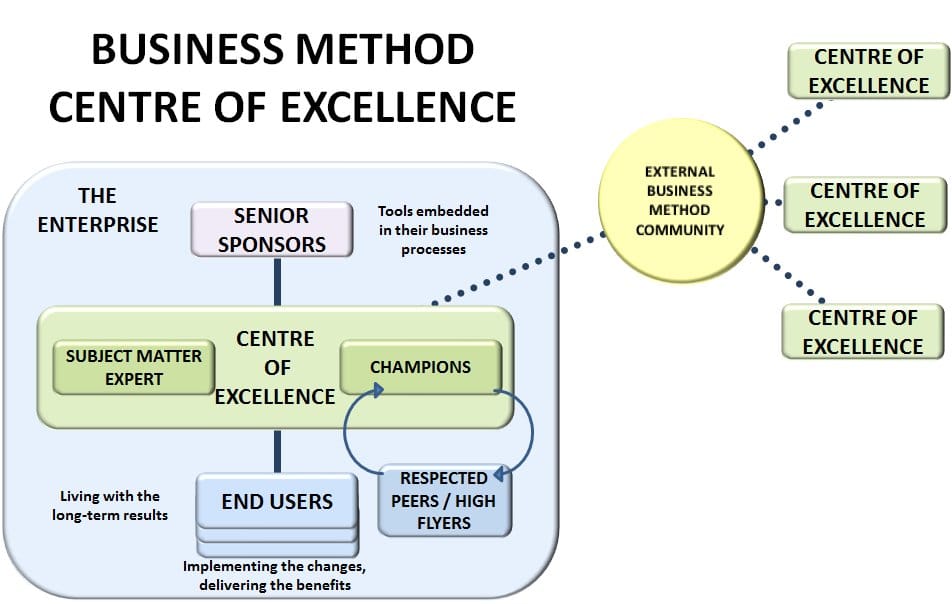
Someone is going to have to provide an element of stability at the centre of the seconded group. This Subject Matter Expertise will provide the common core training to the Champions. It will assure the quality of their work to ensure that everyone is applying consistent best practice. It will support them with higher level skills and techniques to resolve the complex cases. It will collate and analyse lessons learned and look to improve the Method over time. The Champions will depend on them and so have a good incentive to see the right Experts are selected and supported by the organisation. The Experts get to work with the brightest and best (and most demanding). All in all, a much more positive outcome than the traditional Resident Expert will achieve.
So, for the successful implementation of the Method, the best balance is to set up a core group / expert who can maintain and enhance it and to place a broader team of respected secondees around them to champion the Method across the organisation.
Only the largest or most specialist organisations will have the manpower to staff such a centre of excellence fully. The credibility issue is so important that the Champions have to be local, known and respected. However, there is an argument for out-sourcing the subject matter expertise. Most of its skills will be reasonably generic and will be improved by wide experience. The Experts won’t need to know too much about organisation-specific work-flows and personalities. They will need to know the Method inside out and how to apply it appropriately within your organisation.
An external Method hub will bring a breadth of experience and best practice. It also encourages an element of benchmarking competition between members and raises the bar for them all.
Each organisation’s culture, context and budgets will determine where the centre of excellence will sit. It could be in-house, a shared service between similar organisations, a bought-in consultancy or a combination of the three.
Finally, remember that nothing lasts forever. You’ve got your Method beyond being Flavour of the Month and into active use. It’s become ‘the way we do things here’. By all means, keep it going while it’s adding value but recognise when to stop. Don’t let it get in the way when something better comes along.
Summary
The core message boils down to:
You have to sell the concepts
Credibility is key
Senior sponsorship will not last unless tools are established in the processes that the seniors use.
Credibility in the workplace will depend on Champions. These should be respected peers or high-flyers seconded into the Method team
Champions will need Subject Matter Expertise to support them and to maintain and enhance the Method
The location of the Subject Matter Experts will depend on your organisation’s culture, context and budgets
Don’t keep pushing the Method when it’s stopped adding value
Means, motive and opportunity, it works for murderers so why not for managers? • Motive, the force (external or internal) that gives you the need to take action • Means, the relevant physical and intangible resources you have that enable you to take action • Opportunity, the suitable time and place where you can take action
The Modus Operandi
No good detective thriller is complete without a decent modus operandi, the killer’s cunning combination of means, motive and opportunity. The motive sparks their desire. It may be as simple and obvious as the need for money. It can be subtle, personal and indeed perverse (given that murder is in itself wrong, we might be looking at degrees of perversity here). The means, as cheap and brutal as Cluedo’s trusty old lead pipe or as convoluted as an Agatha Christie plot. The opportunity may be a one-off set of circumstances where the killer must decide and strike on an impulse. Or it may be a regular occurrence that gives them time to plan and practice for the perfect crime. Is Professor Plum a casual visitor to the library or can you set your watch by him?
So that’s the story for murderers, where do the managers come into this? The motive also sparks managers’ desire. Where managers differ from murderers is that their motive may not come naturally. If you don’t have a spark of inspiration then go looking for ideas. It’s important to have a motive though. You can’t afford to sit back and let events wash over you. If you do then you will become the victim of other people’s motives. Creativity doesn’t have to be a flash of inspiration, it can come from a thorough analysis of what’s gone before and what the future looks like with all the things you have at your disposal. The means shows you what’s feasible, and it may be more than you first thought. Consider the resources you have or can obtain. It’s not just a question of assets, it’s a matter of capability as well. Back in criminal terms, get the best accomplices you can. The opportunity, strike while you can. Recognise that there will be a limited window of opportunity of time and place when things are just right. Act too soon and you’ll blow it. Wait too long and you will miss your chance. As a rule of thumb, act sooner, rather than later. Even if it all fails, you will be happier knowing that you tried.
Have you ever read a business case, got to page 10 and still not understood what it was for? Worse, have you scrabbled to realise the benefits when no-one could explain why they bought the kit in the first place? We live in a complex world with no simple answers, but maybe there are some simple questions that could help.
Behind every business change there are six seemingly naïve questions:
What does ‘good’ look like around here?
What’s the point of this change?
Who is it really for?
What do they actually want?
How do we get this done?
What makes this option better than Plan B?
The questions are simple, so simple that they are rarely asked. There’s that nagging ‘Emperor’s new clothes’ feel to them:
“Am I the only one who doesn’t get this?”
“Are you really that ignorant or just causing mischief?”
“We’re committed now. How much trouble will I cause if I raise my doubts after we’ve invested so much?”
The answers aren’t simple at all though. Your environment is complex and the cost of investigation may be too high. You may have to compromise. That’s fine, don’t let perfection be the enemy of the good. On the other hand, answers like, “It’s priceless” and “How long is a piece of string?” really won’t cut it.
Your colleagues may not know the answers. They may know but not want to tell you. You may learn more about the culture of your organisation than you do about the change you’re planning to make. If asking your own organisation is awkward, asking your customers, suppliers and partners won’t be any easier.
So why ask the questions if they will bring such grief?
What does ‘good’ look like around here?
This sets the scene. Understand your Vision, Mission, raison d’être, the things you must do and how you know when you are doing them well. Let’s assume that the general reason for any change is to improve something. You’re not deliberately setting out to make things worse. You need to know the baseline of how things are now. You must be able to tell if things are getting better or worse and by how much. In other words you have to have KPIs that really indicate how you are performing against the key things that matter.
If you can’t measure the impact of any change, how will you know it’s been worthwhile?
What’s the point of this change?
The reasons why we make a change affect the way in which we go about making it. You rent a shop on the High Street for the ‘presence’, to let customers examine the goods before they order online. It will have the space and style to encourage them to stay and browse but it won’t need the storage and logistics to shift large amounts of stock. There should be a ‘because’ statement behind every objective, even if it’s implicit, “We will do this because…”
You start with the end in mind, so you need a clear, agreed understanding of what that end will be.
Who is it really for?
Who are the appropriate stakeholders for your change? Who wants it? Who controls how it will happen? Who should receive the benefits? When told that it’s for the customers, remember that there are a number of gatekeepers and advocates between you and your actual customers. You may not be giving the customer what they want so much as giving the Marketing Department what they believe the customer wants. This might not be a bad thing but it is something to keep in mind. Who it’s really for isn’t as obvious as it looks at first sight.
What do they actually want?
A benefit is a result that a stakeholder perceives to be of value. So, having identified the right stakeholders, what do they perceive as being valuable? Perception beats reality nearly every time and perception is subjective. It isn’t easy deciding who the change is for. It’s even harder working out what they genuinely want, whether you can feasibly deliver it and if it’s worth the cost.
How do we get this done?
Up to this point, you’ve got something aspirational, a great idea in theory. So, let’s spoil it all by dragging it back down to reality. “How do we get this done?” moves you on from design to implementation. It reminds you that the results (“What do they actually want?”) will have to be managed in. It’s not just the technology, it’s the objectives and the benefits and all the business change needed to achieve them. Do you control the levers, how far does your influence extend?
You’ve found out who it’s really for and what they actually want. What about all the others who will have to take part in delivering it? Will they do what’s needed? Does everyone involved understand and agree where the boundaries of responsibility lie and who must do what? Have you made promises that aren’t yours to keep?
These issues must be resolved before you can worry properly about the time and resources needed and start drawing up plans.
What makes this option better than Plan B?
Feasibility brings us to our last question, why is this change the best option to take? Why is it the best use of your scarce resources? When you are dealing with profit and finance then the comparison will be relatively (!) straightforward. If you’re looking at Social Return on Investment then life can get just a little more messy. That doesn’t mean that you shouldn’t try though. Unless you own your business, you’re responsible for spending other people’s money so you ought to spend it wisely.
Naïve questions but complex answers
It’s easy to ask the questions, not so easy to get good answers. Ask them at the start, before you’ve invested too much resource and emotion. Use them to select your projects rather than evaluate them after the event. If you do ask them late into the project, at least try to answer the questions honestly and as best you can. Once you know the answers you can improve the present situation and learn valuable lessons for next time.
Bad answers don’t always mean you should stop anything. You can always change the change, do it differently, do something different. Once you’ve got good answers then you’ll have the satisfaction that you’ve picked the right thing to do and the confidence that you can deliver it.
Everybody likes a Maturity Model these days. It’s the management version of Top Trumps. So before you worry about how mature your enterprise is at doing stuff, here’s where you consider the stuff you choose to do in the first place. How good is the process around the business choices you make? Would you like to make it better or are you happy that your luck will continue to see you through?
With a score of 5 being perfection and 1 being, “I’m sorry, were you talking to me?” what would you score against these topics?:
Depth and breadth of knowledge behind the decision
Application of knowledge to the decision
Stakeholder contribution to the decision process
Decision cycle speed
Giving direction
Confidence in delivery
Where do you sit on the maturity scale when it comes to making business decisions?
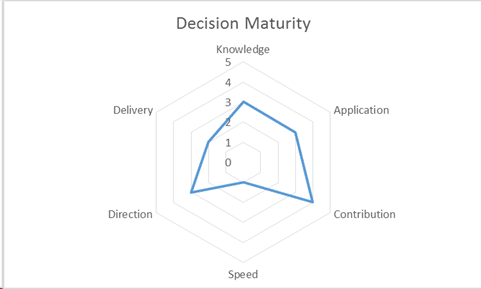
Where would you be on this chart? Does it give you pause for thought?
Waller’s Decision Maturity Model
Fives. Omniscience, omnipotence, alacrity and economy
Knowledge – You know all the relevant information that will inform your decision.
Application – You weigh it and apply it appropriately in making your best choices.
Contribution – All the relevant stakeholders contribute to the decision to the best of their ability.
Speed – Your decision cycle is minimised. Results are achieved as quickly as is possible.
Direction – You convert the decision to clear, concise direction that motivates your stakeholders to act towards a common goal.
Delivery – Stakeholders act on that direction to deliver your desired outcome in the most efficient manner.
Fours. On the upper slopes
You just about know it all. You meet very few surprises.
You use rigorous methods to apply what you know when making choices and you understand what the consequences will be.
You actively consult widely. Most stakeholders contribute to the decision to the best of their ability.
Your decision cycle is optimised with no un-necessary delay. You do not sit on decisions.
You give clear direction so people know what they must do.
Stakeholders act on your direction to deliver a satisfactory result within the tolerances you have set.
Threes. Middle ground
You are reasonably comfortable with what you know. You understand the situation better than most around you.
You apply what you know to your decision but recognise that you still have areas of uncertainty.
You have active contribution by some Stakeholders. The ‘usual suspects’ chip in with their ideas.
You have a recognised decision cycle and allow decisions to be reviewed iteratively, e.g. Plan, Do, Study, Act.
You put what you want into words that most of your people understand.
People mostly do what they should but you expect to make a few mid-course corrections when they stray from your path.
Twos. Mildly embarrassed by your performance
You know that you don’t know it all
There’s a nod towards strategy in your template Business Case.
You know you have some Stakeholders and you talk to your favourites.
You’ve missed the boat a few times and you know you’ve got to be quicker next time.
You think you’ve said what you want doing.
Stuff happens but people keep coming back with difficult questions about what they think they should be doing.
Ones. What problem?
“I didn’t get where I am by sitting around researching stuff.”
“Something must be done. This is something. Let’s do it. Why waste time on a Business Case?”
“I know what people want.”
“This creative stuff is an art, you can’t rush it.”
“You all know what to do. Carry on.”
“Does anyone here know what we’re meant to be doing?”
The Mandate says what you want so it pays to take it seriously.
You’ve patented a widget, you obviously want to do something with it, and you will need help. What do you want to happen next? Here are three alternative mandates.
I’ve patented a new widget:
It’s going to be good. Who’s with me?
Build me your finest widget making machine
Set me up a profitable widget business
Which one comes closest to what you actually want to achieve?
You want support but you haven’t defined any objective and you’re not leading.
The vague mandate gets you a bunch of widget enthusiasts but no tangible results. It’s going to be some time before they make anything. And by that time, it might not look like your widget, and you might no longer be in control.
You obviously want widgets, and you assume the reason why is obvious.
You didn’t think this one through fully. You get the machine you asked for. It might be a very good machine that can make huge quantities of fine widgets. Once it’s working properly, the engineers will move on to their next machine. You have no-one to run yours, so you won’t get much more than a pilot batch of widgets.
This mandate has got a long-term purpose and it recognises that there’s a lot to be done.
In this case the programme covered the whole piece. Discovery did the market research to confirm that widgets would be profitable. Alpha and Beta built a whole profitable enduring business.
As Benefits Managers, we’re always saying, “Start with the end in mind.” The mandate is your first chance to get across your idea of what that end will be. That’s why the mandate matters.
Having looked at some useful tools and techniques, how do you use them in practice? Here are some suggestions that work in an organisation and at a personal level.
Benefits-Oriented Enterprise
This diagram tries to show this by overlaying Benefits Management onto the Inbound / Inside / Outbound model (Buy Side / Inside / Sell Side that some of you will recognise from business studies courses). I’ve drawn it as a Venn diagram because these items are rarely isolated from each other, there’s always a fair amount of overlapping between them.
Even deep within any organisation we have internal customer / supplier relationships. The Buy Side / Inside / Sell Side model is appropriate to all sorts of business units.
Looking at this from a personal point of view, the model still holds up if you consider the following loose definitions:
Strategy = Who you want to be
Inbound = What you take
Inside = What you do
Outbound = What you give
Performance Management = Being who you are
The emphasis here is on the management of benefits, doing the right thing, getting the most good. The other tools we’ve looked at, such as quick decisions, goal setting and hypothesis testing will all help.
Strategy Development (Options & Choices, Who You Want To Be)
This is taking time to think about what affects you, what objectives you want to achieve, who gets the benefits and the pain. Goal Contribution is a strategic business planning tool you can use for selecting and delivering successful business strategies and portfolios. Your Realisation Plan for the new strategy comes from Benefits, not pet projects, fair shares or face saving.
It is using benefits to decide the best course of action to take, doing the right thing.
Use the decision making tools, the time appreciation, quick decision to manage the process of choosing. Then test your hypothesis to check how good an idea you’ve just had. The Goal Contribution Map shows what you’ve chosen, why it’s a good thing and who it’s going to be good for. Adding them all together helps you choose to do the right thing.
Strategic choices overlap all the three key areas, inbound, inside and outbound.
Inbound (What You Take)
This deals with how you act as a customer and take things from other people. If you know the benefits then you know the reasons why you want something and so can negotiate better with your suppliers. You will know the value of what you want and the price you are willing to pay for it. You will decide what you must have and where you can afford to compromise.
Supplier Relationships
Building a relationship with your suppliers is often a better way of doing business than haggling with them. Talking openly to get agreed joint aims and mutual benefits will build a solid working relationship with your key suppliers. As the customer, you create the right hand side, the goals and benefits half of the Goal Contribution Map. The supplier can then map their offered solution as the left hand side. Working together, the diagram can be improved to develop the optimum solution and a strong working relationship into the bargain.
SLAs & Contracts’ Acceptance Criteria
Acceptance Criteria set the boundaries of what a good solution must contain. They become a sort of, “nobody goes home until we’ve achieved…” statement. Define them in terms of the benefits to be delivered rather than the resources input to the system. Formal agreements (contracts, service level agreements) can then be made on the basis of reward for results. Your suppliers get paid on what you get out of the deal rather than how much they put into it.
The relationships you build will influence the ‘paperwork’. Performance against paperwork in turn influences the relationships so it pays to start these well.
Inside (What You Do)
Business As Usual Working Practices
Processes should be viewed from the value they add to the enterprise. This value may not necessarily be in hard financial terms but must be expressed as a benefit that managers feel is worth having. Once established, the aim of any practice must be documented in its works instructions. Stating the ‘ends’ as well as the ‘means’ reminds people why they are doing what they do. Remember that an objective is a result with a purpose. If it’s your job to give orders then, “Just do it” is out. You have to be prepared to explain why an action is necessary and how it connects to the desired result. And the first person you have to explain it to is yourself.
Continuous Improvement
Existing working practices should be subject to continuous improvement. Quality improvement exercises must remember to consider the ‘why’ as much as the ‘how’. Knowing your objectives also helps you improve what you do. It helps you decide the priorities of what things to improve first and suggests what the improvements should look like.
Outbound (What You Give)
Though I will refer to external ‘customers’ here, remember this applies just as well within the enterprise where some of us have to ‘sell’ our services to our colleagues.
Partner Relationships
Open dialogue with a clear understanding of agreed joint aims and mutual benefits will build a solid working relationship with our key partners. The same processes are applied here when you are the supplier as above when you are the customer.
Customer Relationships
If you are actively selling something then Goal Contribution is a pre-sales tool to build a solid relationship with your customer. Together you work to determine their goals and develop a solution that meets them. Shared goals and open discussion help build a partnering relationship that is more likely to succeed than the old ‘hard sell’ routine.
The two sides of the Goal Contribution Map can be constructed in a reasonably straightforward and logical manner. The brainpower comes in making the connections from one side to the other. Having identified the customer’s needs, which alternative solutions can we offer? Having identified a feature of a new disruptive technology, which problem could it solve? If nothing more, the map can act as a conversation piece to start the customer and supplier talking to each other.
Solution Design
Having started the dialogue, Goal Contribution provides a good base on which to develop solutions with customers. Before they put the work out to tender, you can be actively involved in defining the customer’s needs as we work with them to map solutions to goals. This can take significant time and effort if done properly and the customer is unlikely to have the resource to duplicate this sort of exercise with our competitors. The required solution is going to have your imprint simply by your involvement in its definition. However, it will still be expressed in terms of customer benefits, meeting their goals. It will be the solution they want to buy, not apparently the one you want to sell. You should be at an advantage when the Invitation to Tender is issued.
The best way to use the Goal Contribution Map in developing solutions is in partnership with the customer, working through a series of passes back and forth across
Solution Development
As we deal with innovation and disruptive technology we are faced with recurring questions about how it is to be used. Working through the left hand side of the Goal Contribution Map builds reasons for why you should want to use a particular technology. Creating solutions in search of problems is bad if we try to force the solution onto any problem that comes our way. However, Goal Contribution provides a set of potential problems we can solve.
You can see the organisation’s actual priorities from where they are prepared to spend their money. The targets they set define the benefits they want delivered.
You can do this for any customer group, from Board level right the way down to an individual with a project and some money to spend.
This exercise builds up the right hand side of the map. We know what they want to achieve so now we can look at propositions to fit their needs. Knowing the customer side of the Goal Contribution Map will prompt for enablers and features that will connect. Features that lead to dead-ends can be dropped. A feature linked to many or major benefits is likely to be the ‘killer app’ and you can concentrate your effort on it.
Again, the best way to use the map in developing solutions is in partnership with the customer, working through a series of passes back and forth until both sides have their optimum solution.
Bid Summary
When an organisation has a big piece of work to be done, they invite suppliers to bid or tender for the job. Invitations to Tender are often large, complex documents written by a number of authors. A number of people have written a lot of jargon to describe what they think they want. Suppliers submit bids responding to them which are much larger and more complex. Bids contain more jargon describing how the supplier will deliver what they think the customer thinks they want. The opportunity for poor communication and misunderstanding is tremendous. Suppliers may miss the customer’s key drivers. Customers may miss how your solution meets their needs better than your competitors.
The Goal Contribution Map is a very strong tool for displaying graphically how our proposed solution will meet the customer’s requirements. At a glance you have the Executive Summary on one page. Obviously, you need the story to back-up the boxes on the map but the customer can wade through that for the specifics of what we will deliver, not to answer the simple question, “Will this do what I want?”
Again, it is best built in collaboration with the customer. This not only creates the optimal solution, it helps build the relationship.
Project Management (Solution Delivery)
IT Project Management is the ‘home’ of benefits realisation. It’s where the original ideas came from and, I must be honest, executives still struggle to appreciate its wider appeal. You can use Goal Contribution as a differentiator between yourselves and other Project Management providers. Using what you’ve read here you can turn your projects into ones that don’t just build things and install kit but deliver actual benefits.
Performance Management
Performance management is a matter of measuring what’s going on and making changes to fix or improve things. There are shelf-loads of books on managing the performance of an organisation but the same principles can be applied personally as well.
A rational scheme of performance management underpins the entire system. If you can’t measure the benefit, how do you know it’s occurred? This means having baseline figures before you make the business change and on-going measures to show the impact of the change. We need to measure the right things for the right reasons and prove that the benefits are as valuable as we expected and are actually being delivered.
We often narrow down the things we think we can measure so far that we forget their original purpose. Customer spending that contributes to profit becomes customer satisfaction which in turn becomes number of rings to answer or sales visits per week. That’s when people start ‘gaming’ with the targets they’ve been set. The Call Centre answers instantly then fobs you off with an abrupt and wrong answer so they can get straight on to the next caller.
Benefits management helps you choose the appropriate performance to measure, not the easy one. As mentioned earlier in the paragraph on contracts, we measure what we get out of the system, not just what gets put in. Performance management shows how well the benefits are being delivered and enables you to do something to improve the situation.
Hypothesis testing is a way of testing new ideas against your strategy, objectives and context. Before running away with a brilliant new idea, it needs to be checked to see how good it really is and how well it fits with who you are and what you do.
No-one enjoys getting their homework marked, and the same applies with any business assurance process. By the time you hand over your business case to be sense-checked by colleagues, you will already have invested a lot personally, as well as financially. If it’s going through a formal approval process, you really don’t want to be rejected. If it’s the subject of an audit, then it’s probably too late to correct anything and your reputation will be defined by their findings.
Even when all goes well and assurance re-assures you that you’re doing things right, there’s always that period of doubt and anxiety until you get the OK.
If re-assurance is someone taking away your worry after the event, then ‘pre-assurance’ is what you do to take away the cause for worry in the first place. Pre-assurance is all about testing your decision before you pass it over to someone else for comment.
The Idea Test is one way to pre-assure your initiative. It’s a way of testing new ideas against your strategy, objectives and context. Before running away with a brilliant new idea, it needs to be checked to see how good it really is and how well it fits with who you are and what you do.
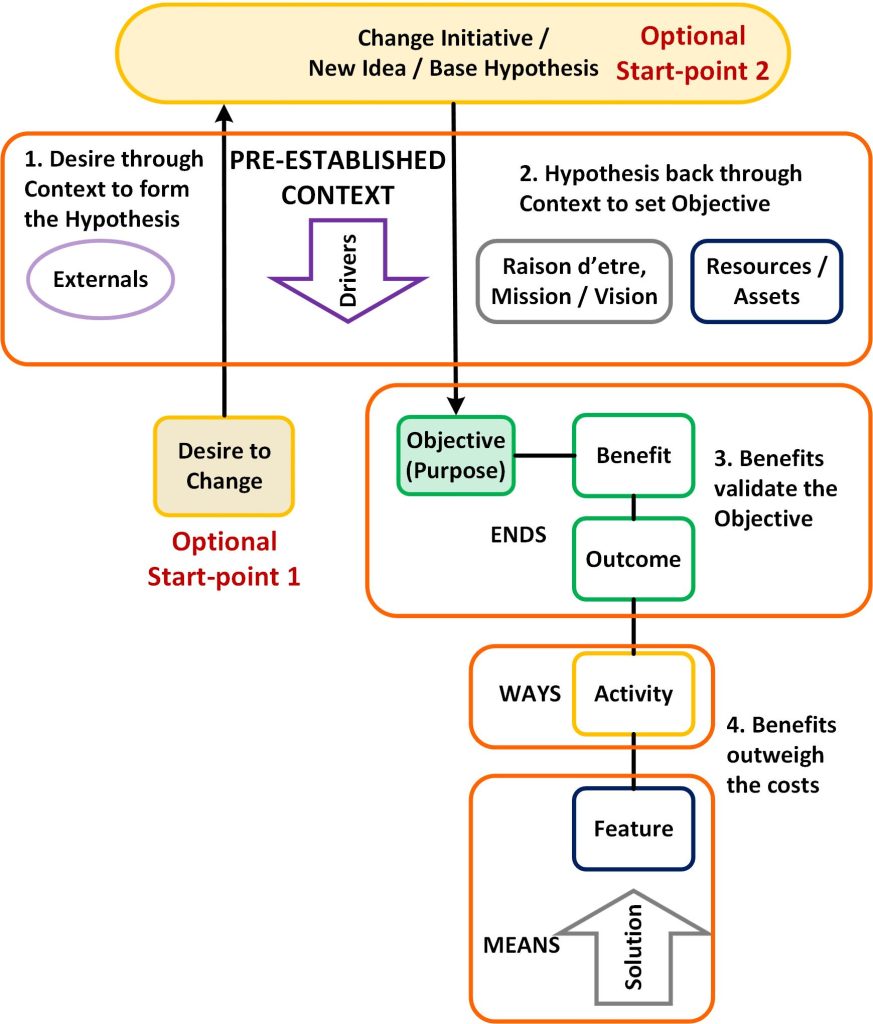
The Idea Test contains checks to take you from hypotheticals to practicality. There are four filters for your investment decision to pass through or fail:
First filter –If you’re looking for change, but you don’t know what it should be, pass your desire to change through your business context. Focus on something that demands action and find your new idea or hypothesis.
Second filter – pass the Hypothesis back through the context to see if it’s relevant and feasible.
Third filter – test the Objective against the benefits and detriments to see if it is desirable.
Fourth filter – test the Benefits against the Plan to prove it is a worthwhile use of resources.
The Idea Test
Pre-established Context
To begin with, you have to set the scene, to understand the context in which you operate. If you don’t know where you are, you can’t be sure where your change will take you.
Who are you, what do you do, what do you think? Understand the purpose and culture of the organisation. What’s your Vision and Mission, your raison d’être? What drives you from outside? Know the externals you work with (competitors, customers, suppliers, partners, society). What resources do you have, physical and intangible, kit and people?
Optional Start-point 1, Desire to Change
Then you can choose to change. At this point, you may not have a particular change in mind. You just know that you can’t stand still, something must be done. Start here if you’re looking for inspiration.
First filter – pass your desire to change through the context to see where the opportunities or gaps lie. Use the Context for some horizon scanning. “What’s happening out there?” “What could be better…?” “What should we fix…?” Try some SWOT analysis. If you don’t already have a Problem Statement, this is where you can create one.
Optional Start-point 2, the Base Hypothesis
The first filter takes your vague desire to change and turns it into a Base Hypothesis, “Why don’t we…?” “Wouldn’t it be good if…?” Often though, someone’s already had the idea and you start here with the Base Hypothesis. If you’re lucky, it’s come from a workshop of rational experts. If not, it’s probably something your boss heard at the Golf Club. Either way, it needs to be checked.
Second filter – pass the Hypothesis through the context to see if it’s relevant, appropriate and feasible. Will your new idea be good for your business? Do you have the capacity and capability to do it?
Are you comfortable that it fits with the sort of people you are? A silly example – you’re the local Temperance Lodge and you need to raise funds. Someone suggests opening a members’ bar. It really doesn’t fit that well with your mission. A more sensible historic example – the supermarket Tesco was basically a giant grocer. Then someone suggested selling financial services. At first sight there’s no connection but thinking about it, Tesco has a huge customer base and knows a lot about their financial state. The company’s purpose is to make profit. The idea made commercial sense and Tesco Bank still exists.
Turn the Hypothesis into an Objective. Go from, “Why don’t we do X?” to, “We will do X because…” The ‘because’ is vital, even if it’s implicit. The purpose behind any course of action has a direct and significant effect on the way it is undertaken. The same applies for any project, the ends affect the means and ways. That’s why a few, clear, SMART objectives are crucial.
You have an objective, a result with a significant and agreed purpose. The next step is to establish the benefits. Most ‘Benefits’ you will see aren’t benefits at all. They’re system features or outcomes, it’s small, fast, painted in friendly colours… So, what is a benefit?
A benefit is a result that a stakeholder perceives to be of value
A benefit needs a stakeholder, someone has to see its merit. “What’s in it for me?” is a subjective judgement.
We use benefits as an aid to setting good objectives. It’s reasonable to expect that our objective will be something to do with bringing benefit to someone, even if it’s purely selfishly to ourselves. The moral and ethical issues can keep for another article. The key points here are a benefit needs a stakeholder, someone has to see its merit, and perception is crucial. “What’s in it for me?” is a subjective judgement. Like morality, issues of relative value, altruism and perverse choices can be left for another day.
However, the definition of benefit helps us define the things around it like outcome and objective. Get away from features and outcomes. It’s got to be perceived as being valuable, e.g. improving sales, reducing complaints, stopping costly processes, not improving network performance, reducing down-time and stopping legacy systems. Use a Benefits Map to plot the cause – effect links.
A basic Goal Model (benefits map) template
A Generic Benefits Map
Third filter – test the Objective against the optimised package of benefits and detriments to see if it is desirable. “If we do X, we will get Y, and we really want Y.” Is the Objective big enough to bother? Too often we do projects without a clear up-front understanding of what benefits they will deliver. ‘Build it and they will come’ is a gamble that maybe we ought not take.
Different stakeholders want different things. Work out who you are doing it for and what they perceive as being valuable. Who are the key ones who have a significant influence on the project? What business changes will they make for the project to be successful? “What’s in it for them?” How committed to success will they be and where do we want them to be? Are the benefits appropriate? “You’re doing this because it brings substantial benefit to the right people”.
Knowing if the benefit will be substantial means putting a price on it. Your benefit may not be cash in the bank, but you still need to know what it’s worth, what you’d be willing to pay if you had to. Later, you’ll have to show that the benefits will outweigh the costs.
Now you have a good feel for what you want, plan to realise the Ends (Objective, Benefits, Outcomes) through the best use of Ways and Means. This is where the Benefits Map comes in useful again. Mapping makes the links and dependencies clearer than tables in a business case. Your plan must include costs and risks so you will know the expense and the chance of success.
Fourth filter – Test the benefits against the costed plan. Is the cost (money, time, stress, lost opportunities) outweighed by the benefits? Will your Big Idea add value?
Test the benefits it delivers against the costs involved to prove it is a worthwhile use of resources. You know the chains of cause – effect from Means to Ends. The benefits you have selected are feasible and properly quantified. You’ve accounted for risk and dependency, so the chances of success are reasonable. All things considered; will you get a satisfactory return on your investment? If not, what can you change in the scope or funding to make it worthwhile?
When your idea has passed through the four filters you know that it is:
Appropriate – it’s the right thing to do
Feasible – the effort required is manageable and within your capabilities
Worthwhile – benefits outweigh the costs and will satisfy the people you want to keep happy, (including you)
You’ve got the makings of a good idea and the start of a successful business case. Then all you have to do is plan, implement, manage, etc., the entertaining stuff…
The Idea Test was introduced to the NHS in England to support the NHS Change Day campaign of 2013. It was updated in 2024 to include the initial desire to change.