Having looked at some useful tools and techniques, how do you use them in practice? Here are some suggestions that work in an organisation and at a personal level.
Benefits-Oriented Enterprise

This diagram tries to show this by overlaying Benefits Management onto the Inbound / Inside / Outbound model (Buy Side / Inside / Sell Side that some of you will recognise from business studies courses). I’ve drawn it as a Venn diagram because these items are rarely isolated from each other, there’s always a fair amount of overlapping between them.
Even deep within any organisation we have internal customer / supplier relationships. The Buy Side / Inside / Sell Side model is appropriate to all sorts of business units.
Looking at this from a personal point of view, the model still holds up if you consider the following loose definitions:
- Strategy = Who you want to be
- Inbound = What you take
- Inside = What you do
- Outbound = What you give
- Performance Management = Being who you are
The emphasis here is on the management of benefits, doing the right thing, getting the most good. The other tools we’ve looked at, such as quick decisions, goal setting and hypothesis testing will all help.
Strategy Development (Options & Choices, Who You Want To Be)
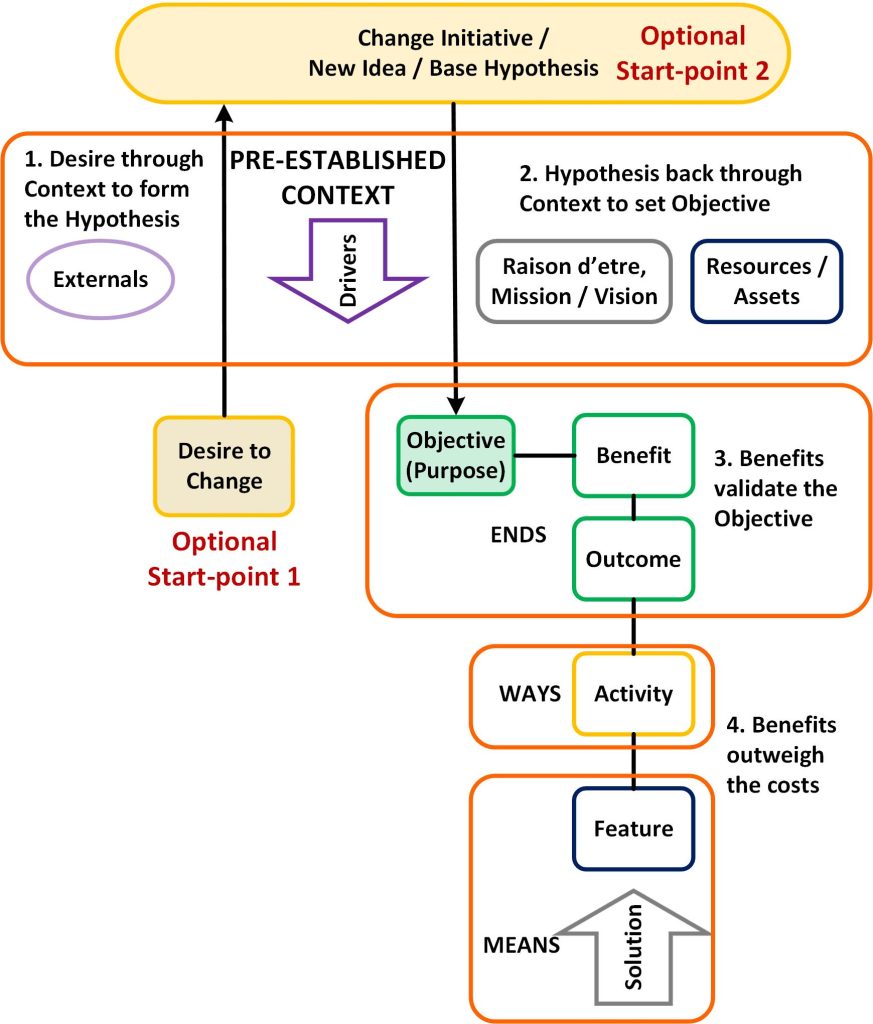
This is taking time to think about what affects you, what objectives you want to achieve, who gets the benefits and the pain. Goal Contribution is a strategic business planning tool you can use for selecting and delivering successful business strategies and portfolios. Your Realisation Plan for the new strategy comes from Benefits, not pet projects, fair shares or face saving.
It is using benefits to decide the best course of action to take, doing the right thing.
Use the decision making tools, the time appreciation, quick decision to manage the process of choosing. Then test your hypothesis to check how good an idea you’ve just had. The Goal Contribution Map shows what you’ve chosen, why it’s a good thing and who it’s going to be good for. Adding them all together helps you choose to do the right thing.
Strategic choices overlap all the three key areas, inbound, inside and outbound.
Inbound (What You Take)
This deals with how you act as a customer and take things from other people. If you know the benefits then you know the reasons why you want something and so can negotiate better with your suppliers. You will know the value of what you want and the price you are willing to pay for it. You will decide what you must have and where you can afford to compromise.
Supplier Relationships
Building a relationship with your suppliers is often a better way of doing business than haggling with them. Talking openly to get agreed joint aims and mutual benefits will build a solid working relationship with your key suppliers. As the customer, you create the right hand side, the goals and benefits half of the Goal Contribution Map. The supplier can then map their offered solution as the left hand side. Working together, the diagram can be improved to develop the optimum solution and a strong working relationship into the bargain.
SLAs & Contracts’ Acceptance Criteria
Acceptance Criteria set the boundaries of what a good solution must contain. They become a sort of, “nobody goes home until we’ve achieved…” statement. Define them in terms of the benefits to be delivered rather than the resources input to the system. Formal agreements (contracts, service level agreements) can then be made on the basis of reward for results. Your suppliers get paid on what you get out of the deal rather than how much they put into it.
The relationships you build will influence the ‘paperwork’. Performance against paperwork in turn influences the relationships so it pays to start these well.
Inside (What You Do)
Business As Usual Working Practices
Processes should be viewed from the value they add to the enterprise. This value may not necessarily be in hard financial terms but must be expressed as a benefit that managers feel is worth having. Once established, the aim of any practice must be documented in its works instructions. Stating the ‘ends’ as well as the ‘means’ reminds people why they are doing what they do. Remember that an objective is a result with a purpose. If it’s your job to give orders then, “Just do it” is out. You have to be prepared to explain why an action is necessary and how it connects to the desired result. And the first person you have to explain it to is yourself.
Continuous Improvement
Existing working practices should be subject to continuous improvement. Quality improvement exercises must remember to consider the ‘why’ as much as the ‘how’. Knowing your objectives also helps you improve what you do. It helps you decide the priorities of what things to improve first and suggests what the improvements should look like.
Outbound (What You Give)
Though I will refer to external ‘customers’ here, remember this applies just as well within the enterprise where some of us have to ‘sell’ our services to our colleagues.
Partner Relationships
Open dialogue with a clear understanding of agreed joint aims and mutual benefits will build a solid working relationship with our key partners. The same processes are applied here when you are the supplier as above when you are the customer.
Customer Relationships
If you are actively selling something then Goal Contribution is a pre-sales tool to build a solid relationship with your customer. Together you work to determine their goals and develop a solution that meets them. Shared goals and open discussion help build a partnering relationship that is more likely to succeed than the old ‘hard sell’ routine.
The two sides of the Goal Contribution Map can be constructed in a reasonably straightforward and logical manner. The brainpower comes in making the connections from one side to the other. Having identified the customer’s needs, which alternative solutions can we offer? Having identified a feature of a new disruptive technology, which problem could it solve? If nothing more, the map can act as a conversation piece to start the customer and supplier talking to each other.
Solution Design
Having started the dialogue, Goal Contribution provides a good base on which to develop solutions with customers. Before they put the work out to tender, you can be actively involved in defining the customer’s needs as we work with them to map solutions to goals. This can take significant time and effort if done properly and the customer is unlikely to have the resource to duplicate this sort of exercise with our competitors. The required solution is going to have your imprint simply by your involvement in its definition. However, it will still be expressed in terms of customer benefits, meeting their goals. It will be the solution they want to buy, not apparently the one you want to sell. You should be at an advantage when the Invitation to Tender is issued.
The best way to use the Goal Contribution Map in developing solutions is in partnership with the customer, working through a series of passes back and forth across
Solution Development
As we deal with innovation and disruptive technology we are faced with recurring questions about how it is to be used. Working through the left hand side of the Goal Contribution Map builds reasons for why you should want to use a particular technology. Creating solutions in search of problems is bad if we try to force the solution onto any problem that comes our way. However, Goal Contribution provides a set of potential problems we can solve.
You can see the organisation’s actual priorities from where they are prepared to spend their money. The targets they set define the benefits they want delivered.
You can do this for any customer group, from Board level right the way down to an individual with a project and some money to spend.
This exercise builds up the right hand side of the map. We know what they want to achieve so now we can look at propositions to fit their needs. Knowing the customer side of the Goal Contribution Map will prompt for enablers and features that will connect. Features that lead to dead-ends can be dropped. A feature linked to many or major benefits is likely to be the ‘killer app’ and you can concentrate your effort on it.
Again, the best way to use the map in developing solutions is in partnership with the customer, working through a series of passes back and forth until both sides have their optimum solution.
Bid Summary
When an organisation has a big piece of work to be done, they invite suppliers to bid or tender for the job. Invitations to Tender are often large, complex documents written by a number of authors. A number of people have written a lot of jargon to describe what they think they want. Suppliers submit bids responding to them which are much larger and more complex. Bids contain more jargon describing how the supplier will deliver what they think the customer thinks they want. The opportunity for poor communication and misunderstanding is tremendous. Suppliers may miss the customer’s key drivers. Customers may miss how your solution meets their needs better than your competitors.
The Goal Contribution Map is a very strong tool for displaying graphically how our proposed solution will meet the customer’s requirements. At a glance you have the Executive Summary on one page. Obviously, you need the story to back-up the boxes on the map but the customer can wade through that for the specifics of what we will deliver, not to answer the simple question, “Will this do what I want?”
Again, it is best built in collaboration with the customer. This not only creates the optimal solution, it helps build the relationship.
Project Management (Solution Delivery)
IT Project Management is the ‘home’ of benefits realisation. It’s where the original ideas came from and, I must be honest, executives still struggle to appreciate its wider appeal. You can use Goal Contribution as a differentiator between yourselves and other Project Management providers. Using what you’ve read here you can turn your projects into ones that don’t just build things and install kit but deliver actual benefits.
Performance Management
Performance management is a matter of measuring what’s going on and making changes to fix or improve things. There are shelf-loads of books on managing the performance of an organisation but the same principles can be applied personally as well.
A rational scheme of performance management underpins the entire system. If you can’t measure the benefit, how do you know it’s occurred? This means having baseline figures before you make the business change and on-going measures to show the impact of the change. We need to measure the right things for the right reasons and prove that the benefits are as valuable as we expected and are actually being delivered.
We often narrow down the things we think we can measure so far that we forget their original purpose. Customer spending that contributes to profit becomes customer satisfaction which in turn becomes number of rings to answer or sales visits per week. That’s when people start ‘gaming’ with the targets they’ve been set. The Call Centre answers instantly then fobs you off with an abrupt and wrong answer so they can get straight on to the next caller.
Benefits management helps you choose the appropriate performance to measure, not the easy one. As mentioned earlier in the paragraph on contracts, we measure what we get out of the system, not just what gets put in. Performance management shows how well the benefits are being delivered and enables you to do something to improve the situation.