Category: Misc

  • Bored with Benefits

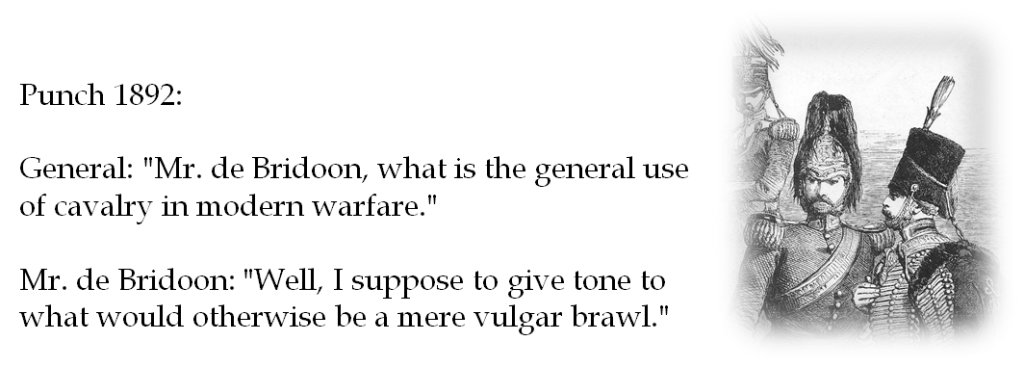
    Victorian Punch cartoon, "The use of cavalry"

    It’s time to move on. I can’t walk into a meeting nowadays without someone mentioning ‘Benefits’ and the thrill has gone.


    To all my Benefits Management colleagues and peers, I’m sorry but while we’ve not pitched our services high enough, the job you have now is about as good as it’s going to get.

    To everyone else, tagging benefits onto your projects is better than nothing, and I appreciate the effort. But it’s not really the whole answer to what you need.

    I don’t want to Realise Benefits anymore. I want to do something bigger than this. I don’t want to draw Benefits Maps. I want to draw Campaign Maps.

    The use of Benefits Management in modern business is to lend an element of rationality to the exercise of power.

    Frankly, it’s not good enough. Power is being exercised and all I seem to do is lend it a little air of rationality, usually long after the decisions have been made.

    The concentration on benefits is better than what we had before. But it’s only part of the story. What we have now is an emphasis on benefits that are rarely strategic, lots of piecemeal rewards that don’t add up to a strategic whole. Too many people think that Benefits are now the treats you give your stakeholders so they will play nicely with each other. The ‘Benefits-Led Organisation’ is likely to be working towards a shopping list rather than a set of strategic objectives.

    “…errant consilia nostra, quia non habent quo derigantur…”

    Our plans miscarry because they have no aim.

    Lucius Annaeus Seneca

    When Seneca wrote this two thousand years ago, his readers probably muttered, “Non stercore, Sherlock.” The problem is hardly new. We don’t put the right effort into our strategy to begin with. It’s time for Benefits Management to raise its game. I want to move on from Benefits Management to Strategy Management. We should all be in it for the strategy, not the benefits.

    Benefits Management as a method supports the better delivery of strategy. The tools and techniques are as valid for the whole organisation as for a single project. I just need people higher up the food-chain to take an interest.

    If you are a leader then take a moment to think about the science as well as the art of leadership. Consider what a little more rationality could do for you.

    If you’re a Benefits Manager then it’s time we got our heads together and raised some awareness of what we can do for our leaders.

  • Educate, Agitate, Organise

    Motivating change

    [This first appeared as a Guest Blog for Sayers Solutions, May 2013]

    I was going through the family heirlooms and found my dad’s old Trade Union badge blazoned with the motto, “Educate, Agitate, Organise”. It’s a phrase that I haven’t thought about for a long time. It’s good though, when you look at it. If you want to get something changed, this is how to do it, summed in three words.

    Educate – “Did you know that…?”

    Agitate – “Don’t you think we should…?

    Organise – “Then let’s go do…”


    There you have it, how to lead change in three words (and an awful lot of work in the background, glib phrases on their own aren’t enough).

    Educate

    Do you have a message you want to get across? Is it something short, meaningful and bound to make an impact on the people you tell? If it isn’t, can you re-phrase it so it is? Consider the things you don’t know. Your customers and colleagues have their own messages they want to tell you if you give them the right opportunity.

    You can’t change everything at once so look to the benefits. See which change has the biggest impact and who gets the most out of it. Check that it’s feasible and the benefits easily outweigh the costs. That means measuring them and knowing your present baseline. Like I said, an awful lot of work in the background, but it’s best to put the effort in at the start and do something worthwhile. 

    Agitate

    Having chosen to make a change, you’ve got to motivate people to go along with you. You need a compelling story that appeals to your audience. Where you have more than one audience you may need more than one story. But you have to maintain your integrity here. You can’t go about telling everyone what you think they want to hear. Apart from the fact that it’s just wrong, they will catch you out eventually. 

    Organise

    Now comes the dull, hard part. You’ve chosen your Big Idea, everyone’s raring to go, now you’ve got to sort out the practical stuff of who does what, when. There are libraries of books on planning so I’ll not try to cover it here. I will say though that you need to invest more in the change than you do in the hardware. Projects often fail because they spend a lot on the new kit and then try to do business change on the cheap, squeezing it into people’s day-jobs instead of investing in it properly.

    One final thing, don’t treat these three as a sequence of events. Look on them more as a loop. As you learn lessons, re-educate. Agitate constantly, keep up constant communication. Organise flexibly as circumstances change around you.

    So far I’ve failed to find out who invented the phrase. It’s got roots in Victorian socialism, but I haven’t traced its author. Could someone please tell me? I think they deserve a bit of acknowledgement.

  • Pan Narrens

    The story-telling ape and how he spoils your choices.

    A chimpanzee sat on the ground, shouting

    “In last week’s email, we shared how different business owners were winning the selling game by telling great stories.”

    A typical business development blog

    Those of you who like their education with a bit of entertainment may well know the series of books on the Science of Discworld by Terry Pratchett, Ian Stewart and Jack Cohen. One of the minor items that falls out of their broad remit of the whole of science is Pan Narrans, the storytelling ape (The Science of Discworld II – The Globe). Very briefly, instead of being Homo Sapiens, mankind ought to be described as Pan Narrans as we’re not much above the chimpanzee, we simply tell stories more eloquently.

    It’s this evolutionary development of storytelling and our dependence upon it that affects the way we act together and the choices that we make, not always in a good way.

    “History is written by the winners. Though not greyhounds and racehorses.”

    Alexei Sayle’s Imaginary Sandwich Bar – Britain’s place in the world, Radio 4, 09/11/17

    What about the content of the story, the plot, the characters?

    I once went to a business seminar, the sort where the panel of millionaires takes questions. Inevitably, the question arose, “As a truly successful businessman, what is your advice to an entrepreneur just starting out?”

    Came the, also inevitable answer, “Don’t give up. Keep at it. Eventually, you’ll make a sale.”

    Then the epiphany struck me. The answer boiled down to, “Keep pushing your stupid product until you find someone more stupid than you who will buy it.”

    Stories have heroes who live to tell the tale, they have million to one chances, they have the rewards of perseverance. Reality has heroes who never come back, punters who bet all and lose, unrequited lovers who die old and lonely and unfulfilled. And it has many more of all three.

    Two-thirds of companies fail within three years. Sixty per cent of projects fail. If we base too many of our choices on the stories we hear from the lucky few then we risk falling into the unlucky many.

    That doesn’t mean we shouldn’t try, that we shouldn’t be inspired, that we shouldn’t hope. It means that we ought to consider the chances of success and the consequences for ourselves and those close to us. Re-possessed houses rarely have only one occupant. Bankrupt firms have workforces.

    It means putting in the effort up-front to make the best choices in the first place. Von Clausewitz talks about the selection and maintenance of the aim. Maintenance is great if you selected the right thing in the first place. It has its downside when you picked the wrong one.

    I know that stories appeal to our emotion, not our rationality. I’m just asking that we take a pause and put a little rationality into the mix before taking that leap of faith.

    We’ll always need stories. We are Pan Narrans after all. What we need is the right sort of stories. “Once upon a time, a group got together and worked on a problem until they came up with a sensible solution…”